About Torgos tracheliotos (J.R.Forster, 1796)
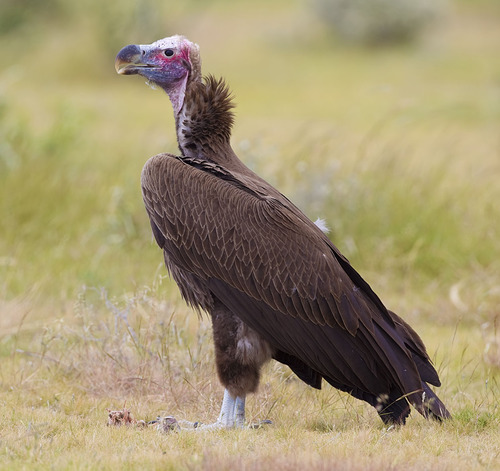
The lappet-faced vulture (scientific name Torgos tracheliotos, first described by J.R.Forster in 1796) is a very large vulture species. Within its native range, it is the longest vulture and has the largest wingspan, second only to the closely related cinereous vulture. Some co-occurring Gyps vultures, particularly the Cape vulture and Eurasian griffon, tend to have a higher average body weight.
This vulture has a body length of approximately 95–115 cm (37–45 in), and a wingspan of 2.5–2.9 m (8.2–9.5 ft). Standard body measurements are as follows: wing chord 71.5–82.5 cm (28.1–32.5 in), tail length 33–36 cm (13–14 in), and tarsus length 12.2–15 cm (4.8–5.9 in). Its bill can reach up to 10 cm (3.9 in) long and 5 cm (2.0 in) deep, making it one of the largest bills among all accipitrids, though the reported culmen length of 7.2 cm (2.8 in) is slightly shorter than that of the cinereous vulture.
Body weight varies by subspecies and location: wild individuals of the nominate subspecies T. t. tracheliotus weigh 4.4 to 9.4 kg (9.7 to 20.7 lb), and those in East Africa average only 6.2 kg (14 lb). Captive individuals of the larger subspecies T. t. negevensis weigh 6.5–9.2 kg (14–20 lb) for males, and 10.5–13.6 kg (23–30 lb) for females.
In overall plumage, the lappet-faced vulture is blackish on the upperparts, with strongly contrasting white thigh feathers. African individuals have brown-lined black back feathers, while Arabian individuals are dark brown rather than black on the upperparts. The underside plumage ranges from pure white to buff-brown. Like many vultures, it has a bald head; head coloration varies by region: reddish in southern Africa, dull pink in northern Africa, and pink on the back of the head with gray on the front for Arabian populations. The combination of this colored head and the fleshy folds along the side of the head is distinctive. The bald head is an advantage when feeding, as a feathered head would become spattered with blood and other fluids and be difficult to keep clean.
In flight, lappet-faced vultures have large, broad wings held with parallel leading edges, and slightly pointed wingtips that look serrated. It is considerably larger than the similarly patterned hooded vulture and has a much more massive bill, and can only be mistaken for the hooded vulture from a great distance. Gyps vultures are generally much paler, with less white lining on the wings and more bulging secondary flight feathers. The cinereous vulture, which may share range with the lappet-faced vulture in the Arabian region, has a similar body shape but is entirely dark with no contrasting plumage.
This species has a patchy distribution across much of Africa and the Arabian Peninsula. It is absent from most of central and western Africa, and its populations are declining across the rest of its range. Confirmed breeding countries in Africa are Senegal, Mali, Mauritania, Burkina Faso, Niger, Chad, Sudan, Egypt, Ethiopia, Somalia, Kenya, Tanzania, Uganda, Rwanda, the Democratic Republic of the Congo, Zambia, Malawi, Mozambique, Eswatini, South Africa, Zimbabwe, Botswana and Namibia. On the Arabian Peninsula, breeding occurs in Yemen, Oman, the United Arab Emirates and Saudi Arabia. The species is also present in Gambia, Guinea, Ivory Coast, Benin, the Central African Republic and Angola, with a single vagrant record from Kuwait.
The lappet-faced vulture prefers habitats including dry savannah, thornbush, arid plains, deserts with scattered trees in wadis, and open mountain slopes. It is usually found in undisturbed open country with scattered trees, and appears to prefer areas with minimal grass cover. While foraging, it may wander into denser habitats and even human-populated areas, especially when attracted to road-killed animals. It can be found at elevations ranging from sea level to 4,500 m (14,800 ft).