About Tordylium apulum L.
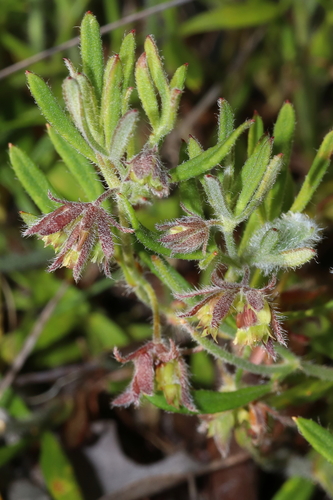
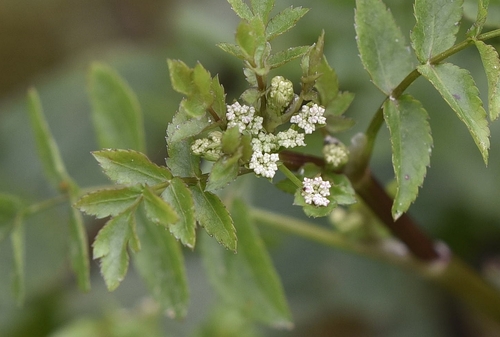
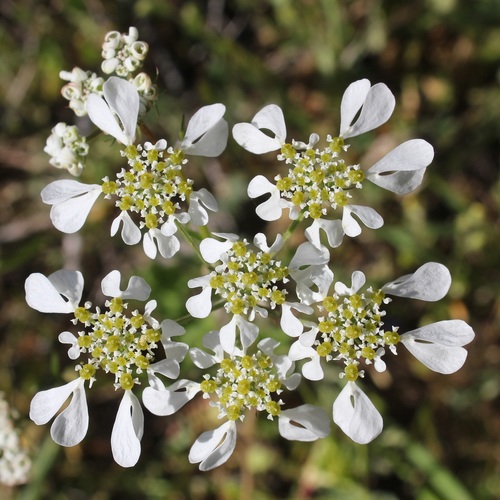
Tordylium apulum L., commonly called Mediterranean hartwort, typically reaches 20 to 50 centimeters in height. It has an erect, branched stem with soft, spreading hairs at its base and scattered hairs along the rest of the stem. Its leaves are softly hairy and pinnate: lower leaves are oval with toothed segments, while upper leaves have linear segments. The plant produces 2 to 8 primary rays. Marginal flowers each have one enlarged white petal that is uniformly deeply two-lobed. Its bracts and bracteoles are linear, long-pointed, and covered in spreading hairs. The fruit is round, flattened, elaborately textured, and usually measures 5 to 8 millimeters across. Mediterranean hartwort occurs as a weed of cultivated areas, and also grows on waste ground and alongside waysides. It grows well in sandy, loamy, and clay soils, and tolerates acid, neutral, and basic soils, but does not grow well in shade. The flowers of this species are hermaphrodite, pollinated by insects, and the plant is self-fertile. Its leaves are edible: in Greece, they are used as a potherb and salad vegetable, while in Italy they are used as a condiment. The composition of essential oil extracted from the aerial parts of Tordylium apulum L. collected from Italy has been analyzed; 67 compounds were identified, making up 96.5% of the total oil. The most abundant compounds in this Italian sample were (E)-β-ocimene (17.3%), α-humulene (11.4%), and octyl octanoate (8.8%). For essential oil from the aerial parts of T. apulum collected in Greece, α-humulene (28.7%) and octyl hexanoate (11.7%) are reported as the main constituents. There are no known medicinal uses for this plant.