About Tomares ballus (Fabricius, 1787)
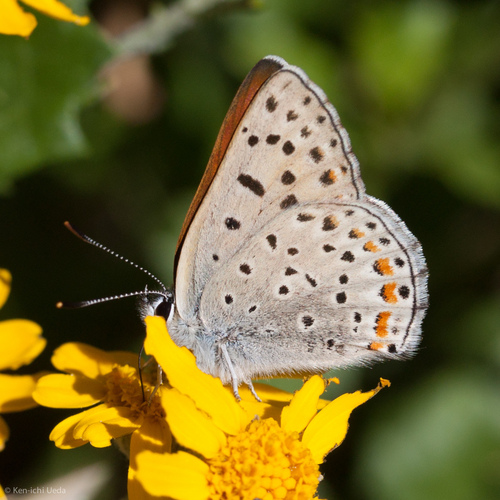
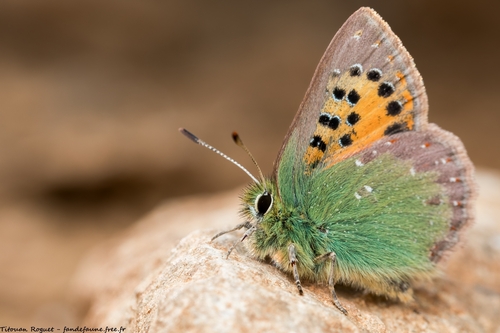
This description of Tomares ballus (Fabricius, 1787) is reproduced from Seitz. Males are dark brown on the upper wing surface, with faint small red spots on the anal area of the hindwing. The larger female has red-yellow forewings except for the costal and distal margins, and a similarly colored ovate band-shaped spot before the distal margin of the hindmargin. The underside of the wings for both sexes resembles that of Chrysophanus phlaeas, but the basal area of the hindwing is dusted with verdigris. This species is found in the French Riviera, Spain, and North Africa. The egg is green, somewhat flattened, marked with a network of polygonal shapes, and laid singly on the upper surface of leaves of Boujeania hispida. The larva is rather thick, not as flattened as most other Lycaenids, with swollen segments separated by deep incisions. It is greenish yellow, with a blue dorsal stripe and a red-brown lateral stripe, with thin oblique streaks between these two stripes. It develops inside the pods of its food plant until the end of May. The pupa is ovate, rounded all over, with fine shallow puncturation; as far as is currently known, the larva pupates freely on the ground. Adult butterflies emerge from February to April in areas where their food plant grows, and are often extremely abundant. When captured in a net, specimens often drop to the ground and hide in grass. The wingspan of this butterfly is 28–30 mm. It flies from January to April. Its larvae feed on Astragalus lusitanicus, Medicago, Dorycnium, Lotus and Anthyllis.