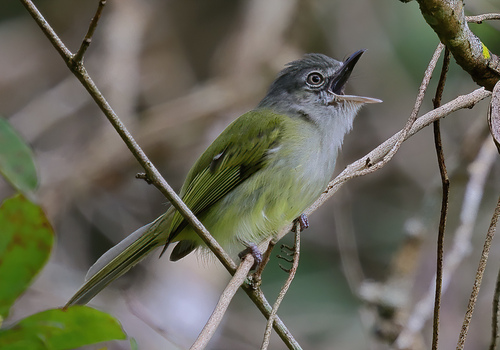
About Tolmomyias sulphurescens (Spix, 1825)
Scientific name: Tolmomyias sulphurescens (Spix, 1825)
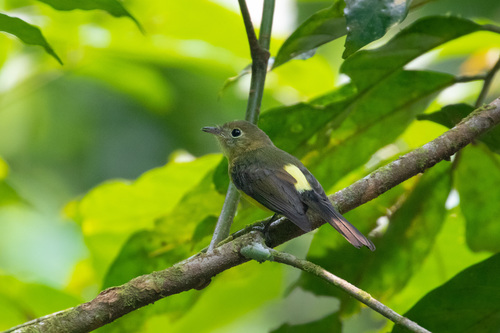
Description: The yellow-olive flatbill is 12.5 to 14 cm (4.9 to 5.5 in) long and weighs 14.5 to 15.2 g (0.51 to 0.54 oz). Both sexes share identical plumage. Adults of the nominate subspecies T. s. sulphurescens have a dark olive crown and nape, a thin white band above the lores, a thin white eye-ring, and pale olive ear coverts with a dusky patch at their rear. Their upperparts are olive-green. Their wings are dusky or blackish, with yellowish-olive edges on the wing coverts that form two distinct wing bars. Their flight feathers (remiges) have yellowish edges. Their tail is brownish to dusky, with buffy edges on individual feathers. Their throat is pale greenish gray, their breast and flanks are grayish greenish olive, and their belly and undertail coverts are bright yellow. They have a variable pale brown to pale gray iris, a wide flat bill with a black upper mandible (maxilla) and a pale gray to pale pinkish lower mandible (mandible), and gray legs and feet. Juveniles have paler underparts than adults, a broken eye-ring, and a dark iris.
Other subspecies of the yellow-olive flatbill differ from the nominate subspecies and from each other as follows: T. s. cinereiceps has a light gray crown, no dusky mark behind the ear coverts, pale gray cheeks and throat, pale yellow belly, and pale gray or whitish to pale yellow iris. T. s. flavoolivaceus has a smaller dusky facial mark and a greener throat than the nominate. T. s. exortivus has a slightly gray olive crown, gray chin, dull olive breast, and medium-yellow belly. T. s. berlepschi is very similar to exortivus, with a slightly duller yellow belly. T. s. asemus has a gray crown, gray throat and breast, and a paler yellow belly than the nominate. T. s. confusus has a medium gray crown, dull olive breast, and medium-yellow belly. T. s. cherriei is very similar to exortivus, with a slightly duller yellow belly. T. s. duidae is similar to cherriei, with a darker olive crown and breast. T. s. aequatorialis has a dark gray crown, dull yellow-green breast, and dark iris. T. s. peruvianus has a dark gray crown, large facial patch, pale gray-green throat, dull olive breast, and dark iris. T. s. insignis has an olive-gray crown and duller underparts than peruvianus. T. s. mixtus has a darker crown than the nominate and a medium-yellow belly. T. s. inornatus is very similar to insignis, but has a less olive crown, less apparent facial mark, and paler underparts. T. s. pallescens has a darker olive crown, paler cheeks, brighter green upperparts, and greener breast than the nominate, plus a grayish iris. T. s. grisescens has a darker olive crown, paler cheeks, brighter green upperparts, and greener breast than the nominate, plus a grayish iris.
Distribution and habitat: The subspecies of the yellow-olive flatbill have the following ranges: T. s. cinereiceps ranges from southern Veracruz, northern Oaxaca, and the Yucatán Peninsula in southern Mexico, south along both the Caribbean and Pacific slopes into Costa Rica, and continues along the Pacific slope into western Panama. T. s. flavoolivaceus is found in Panama from Chiriquí Province on the Pacific slope and Colón Province on the Caribbean, south into northwestern Colombia's Bolívar Department. T. s. berlepschi is found on Trinidad. T. s. exortivus ranges from Sucre Department in northeastern Colombia east into Venezuela north of the Orinoco River, reaching Sucre and Monagas states. T. s. asemus is found in western Colombia from Chocó Department south to southwestern Cauca Department, and also more centrally in the upper Cauca River and Magdalena River valleys in southern Huila Department. T. s. confusus ranges from Táchira and western Apure states in southwestern Venezuela, west into Colombia to the upper Magdalena Valley, and south along the eastern slope of Colombia's Eastern Andes into northeastern Ecuador as far as western Sucumbíos and Napo provinces. T. s. duidae ranges from Amazonas and southern Bolívar states in southern Venezuela into northern Amazonas state in northwestern Brazil. T. s. aequatorialis ranges from Esmeraldas Province in northeastern Ecuador south through western Ecuador into northern Peru's Tumbes and Piura departments. T. s. cherriei ranges from Delta Amacuro and Bolívar states in eastern Venezuela east through the Guianas and northern Brazil, from the upper Branco River to the Atlantic coast in Amapá. T. s. peruvianus ranges from southeastern Ecuador's Morona-Santiago Province south through central Peru to Junín Department. T. s. insignis occurs south of the Amazon from Loreto Department in northeastern Peru east through northwestern Brazil to the Madeira River, and north of the Amazon in Brazil from the lower Negro River east to the Nhamundá River. T. s. mixtus is found in eastern Pará and northwestern Maranhão in northeastern Brazil. T. s. inornatus is found in Puno Department in southeastern Peru. T. s. pallescens occurs in Brazil within an area roughly bounded by southern Maranhão, Paraíba, and Bahia states in the north and east; it extends south and west through Mato Grosso, and south through eastern Bolivia into northwestern Argentina as far as Tucumán Province. T. s. grisescens ranges from central Paraguay south through Argentina's eastern Formosa and Chaco provinces into northern Santa Fe Province. T. s. sulphurescens ranges from eastern Minas Gerais and Espírito Santo states in southeastern Brazil south through eastern Paraguay into northeastern Argentina's Misiones Province, and extends slightly into far northern Uruguay.
The yellow-olive flatbill lives in a wide variety of forest landscapes, including rainforest, montane forest, deciduous and semi-deciduous woodlands, secondary forest, and gallery forest. It typically does not live in humid lowland forest. Subspecies T. s. insignis is most often found on river islands and the adjacent mainland. In terms of elevation, the species ranges up to 1,850 m (6,100 ft) in northern Central America, though it is usually found below 1,550 m (5,100 ft) there. It reaches 1,200 m (3,900 ft) in Mexico, 1,400 m (4,600 ft) in Costa Rica, and 1,800 m (5,900 ft) in Colombia and western Ecuador. In Venezuela, it reaches 1,900 m (6,200 ft) north of the Orinoco River and 1,500 m (4,900 ft) south of the river. In eastern Ecuador it ranges between 700 and 1,700 m (2,300 and 5,600 ft), in northern Peru between 400 and 1,675 m (1,300 and 5,500 ft), and east of the Andes in Peru between 1,000 and 2,400 m (3,300 and 7,900 ft).