About Tolmomyias poliocephalus (Taczanowski, 1884)
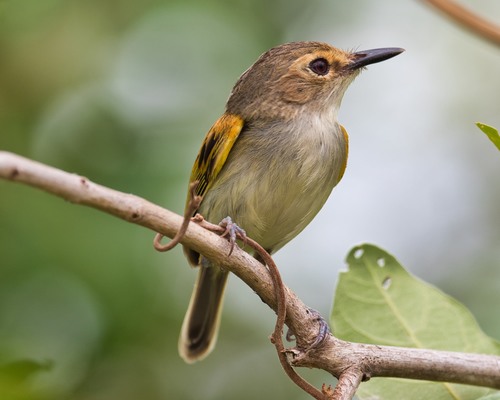
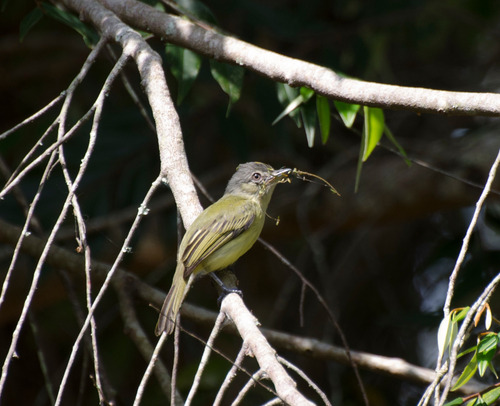
Scientific name: Tolmomyias poliocephalus (Taczanowski, 1884). Common name: gray-crowned flatbill. This bird species measures 12 to 12.5 cm (4.7 to 4.9 in) in length and weighs approximately 11 g (0.39 oz). Males and females have identical plumage. Adults of the nominate subspecies have a mostly gray head, with a whitish stripe above the lores, a faint whitish eye-ring, and greenish gray ear coverts. Their back, rump, and uppertail coverts are olive. Their wings are blackish, with yellow edges on the coverts and remiges that form two wing bars, and sometimes a pale speculum. Their throat is greenish, their breast and flanks are olive, and their belly and vent are pale yellow. Subspecies T. p. sclateri has a pale gray throat, a duller green back, and a paler yellow belly than the nominate subspecies. T. p. klagesi is intermediate in characteristics between the nominate subspecies and T. p. sclateri. All subspecies have an iris that is yellow, pale gray, or pale brown. They have a wide, flat bill: the maxilla is black, and the dark mandible has an orange-pink base. Their legs and feet are gray. The borders between this species' subspecies are not well defined. The nominate subspecies, the most well-studied, is found from southern Amazonas state in southwestern Venezuela, south through eastern and southeastern Colombia, eastern Ecuador, and eastern Peru, and east into western Brazil to the lower Negro and Tefé rivers. T. p. klagesi has a limited range in central and eastern Venezuela, from Delta Amacuro south through Bolívar into northern Amazonas. T. p. sclateri has a disjunct distribution. Its main population adjoins the ranges of the other two subspecies, extending through the Guianas east across northern Brazil to the Atlantic coast, and south through western Brazil to northern and central Bolivia. A smaller separate population is located in eastern Brazil, from Pernambuco south to Espírito Santo. The gray-crowned flatbill primarily inhabits humid forest, including both terra firme and várzea types. It also occurs in mature secondary forest. It mostly remains in the forest from the mid-story to the canopy. In terms of elevation, it mostly occurs below 600 m (2,000 ft), though it reaches 1,000 m (3,300 ft) in Venezuela and Peru, and locally as high as 1,400 m (4,600 ft) in Peru.