About Todirostrum poliocephalum (Wied-Neuwied, 1831)
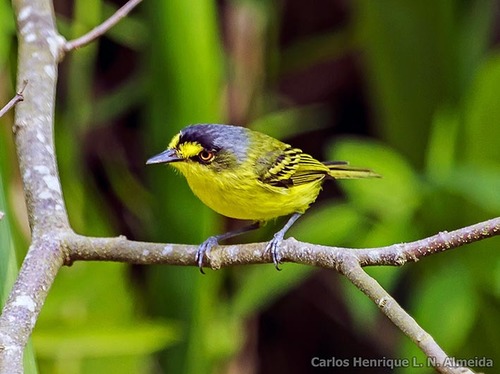
The yellow-lored tody-flycatcher (scientific name Todirostrum poliocephalum (Wied-Neuwied, 1831)) measures 8.8 to 10.2 cm (3.5 to 4.0 inches) in length and weighs approximately 5 to 6 grams (0.18 to 0.21 ounces). Males and females have identical plumage. Adult individuals have a slate-gray crown and nape, large lemon yellow or sulphur yellow patches on the lores, a black stripe below the lore patches, and greenish cheeks. Their back, rump, and uppertail coverts are "siskin-green," a term used by Wied, or olive. Their wings are black-brown, with yellow-green edges on the flight feathers and yellow or olive edges on the coverts; the covert edges form two distinct wing bars. Their tail is dark grayish brown with olive-green edges on each feather. All of their underparts are colored lemon yellow or sulphur yellow. Juveniles have pale yellow lores with a grayish stripe below the lores, and paler yellow underparts than adults. Adults have a yellow-orange iris, a spatula-shaped black-brown bill, and bluish gray legs and feet. Juveniles have a gray-brown iris, a gray bill, and bluish gray legs and feet.
The yellow-lored tody-flycatcher is distributed in southeastern Brazil, ranging from southeastern Bahia south to the far northeastern part of Rio Grande do Sul, and inland into Minas Gerais and northern Paraná. A small number of individuals are also found in Goiás, and this population is suspected to have come from escaped or released captive birds. The species mainly lives in a variety of forest types, and is most often found in dense vegetation along forest edges. It also occurs in more open areas including light woodland, gardens, and urban parks. Near the coast, it is frequently found in humid secondary forest and forest fragments. Further inland, it occurs in semi-deciduous forest, gallery forest, and fragmented forest. It occurs at elevations ranging from sea level up to 1,200 m (3,900 ft).