About Todirostrum nigriceps P.L.Sclater, 1855
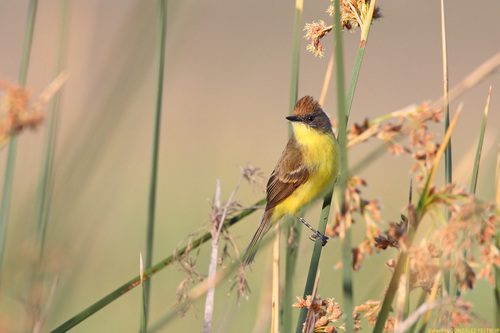
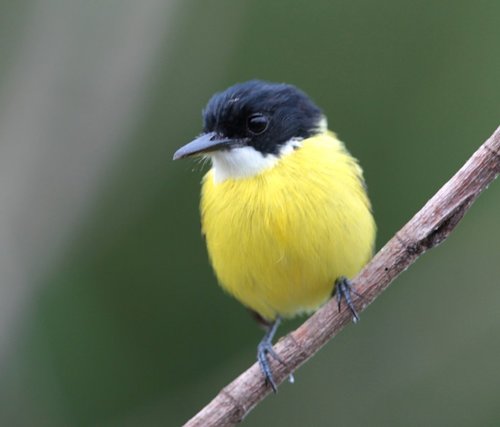
The black-headed tody flycatcher, scientifically named Todirostrum nigriceps P.L.Sclater, 1855, is a small bird. Adult individuals have a glossy black head, white throat, and black coloring that extends down the sides of the neck. Their underparts are bright yellow, and their upperparts are olive-yellow. Their wings are black, marked with two yellow wingbars and yellow streaking, and their tail is short and black. They have a relatively large head, a straight black bill, dark irises, no eye-rings, and blueish-gray legs. Adult males and females have identical plumage. Adults measure between 8 and 10.2 cm in length and weigh 6 to 6.5 g. Juveniles have slightly duller overall plumage, pale yellow underparts, a vaguely yellow throat, duller black heads, and more olive-tinged wingbars. This species is often confused with the common tody flycatcher Todirostrum cinereum, which has a yellow throat and a white eye-ring. Other similar species are the painted tody-flycatcher Todirostrum pictum, which has black-streaked underparts and a yellow throat, and the yellow-browed tody-flycatcher Todirostrum chrysocrotaphum, which has a yellow and black throat and a yellow supercilium. The black-headed tody-flycatcher is a non-migratory Neotropical species. Its range covers mainly southern Central America and north-western South America, including eastern Costa Rica, Panama, and northern and western Colombia; it has also been recorded in far western Venezuela and western Ecuador. While individuals have been found at altitudes up to 1500 m, the species does not extend its range into the Andes. Instead, its distribution borders the mountains, and it is occasionally found in the valleys between the Colombian cordilleras. This is a tree-dwelling species that stays in the canopy and edges of humid forests. It is highly selective of its habitat, mostly choosing the tallest trees. It has also been observed in second-growth forests altered by human disturbance. For reproduction, black-headed tody flycatchers build hanging nests from tree branches using plant fibers, lined with down feathers. Both participating adults contribute to nest construction. They often place their nests near wasp nests to secure a nearby food source. Nesting timing varies by location, but most nesting occurs between June and August; adults in breeding condition have also been recorded in February. Clutches typically contain only one egg. The egg is white, with sparse yellow-brown spotting and rust-colored ends. Occasionally, Piratic flycatchers Legatus leucophaius usurp the nests of black-headed tody-flycatchers to use for their own breeding.