About Todirostrum maculatum (Desmarest, 1806)
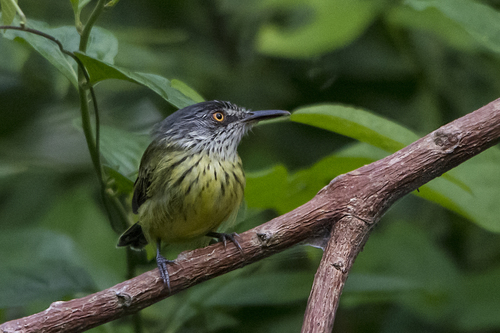
The spotted tody-flycatcher (Todirostrum maculatum, first described by Desmarest in 1806) measures 8.9 to 10.2 cm (3.5 to 4.0 in) in length and weighs 6.4 to 8.3 g (0.23 to 0.29 oz). Males and females have identical plumage. Adults of the nominate subspecies T. m. maculatum have a mostly gray head with a small white spot above the lores and some black and white streaks on the crown. Their back, rump, and uppertail coverts are olive. Their wings are brownish black, with yellow edges on the flight feathers, and yellowish edges and tips on the coverts; the coverts' colored edges and tips sometimes appear as pale wing bars. Their tail is brownish black, with yellow-white edges on the outer webs of the outer feathers. Their throat and upper breast are white with narrow black streaks. Their belly is mostly yellow with dark olive streaks along the sides. Immature spotted tody-flycatchers are very similar to adults, but have thinner, paler streaks. Subspecies T. m. amacurense and T. m. signatum have sooty-black crowns, but are otherwise identical in appearance to the nominate subspecies. T. m. diversum and T. m. annectens have the same plumage as the nominate subspecies. For both sexes of all subspecies, the iris is most commonly yellowish orange, though it may sometimes be gray or brown. This species has a black bill with some white on the mandible, and pinkish gray legs and feet. The spotted tody-flycatcher is native to the Amazon Basin and coastal northern South America. Its range surrounds, but does not include, the Guiana Shield. Each subspecies has a distinct distribution: T. m. amacurense is found in Trinidad, northeastern Venezuela from Sucre to Delta Amacuro, and extends into northern Guyana. T. m. maculatum occurs in Suriname, French Guiana, and the Brazilian states of Amapá, eastern Pará, and northern Maranhão in northeastern Brazil, east of the Xingu River. T. m. signatum ranges from the Caquetá and Putumayo departments of southeastern Colombia, south through eastern Ecuador and eastern Peru into northwestern Bolivia, and east from these areas into the western parts of Amazonas and Rondônia in western Brazil. T. m. diversum is found in central Brazil: north of the Amazon River between the Negro and Nhamundá rivers, and south of the Amazon River from the Tefé River east to the Tapajos River. T. m. annectens occurs in northern Brazil, from the Branco River and northeastern Amazonas south to the confluence of the Negro River and the Amazon River. The spotted tody-flycatcher primarily inhabits wet landscapes, including mangroves along the northern coast, and dense thickets along oxbow lakes, small and medium-sized watercourses, and major rivers and their river islands in the interior. It also occurs in somewhat more open shrubby areas such as forest clearings and abandoned pastures, and has been recorded in residential gardens and grassy areas with young Cecropia plants. Across its entire range, it occurs at elevations up to 500 m (1,600 ft). Its maximum elevation is lower in some countries: 400 m (1,300 ft) in Colombia, 250 m (800 ft) in Ecuador, and 100 m (300 ft) in Venezuela.