About Todirostrum cinereum (Linnaeus, 1766)
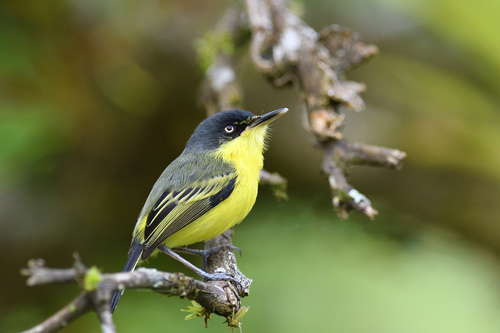
The common tody-flycatcher (Todirostrum cinereum, first described by Linnaeus in 1766) is a tiny bird with a large head, measuring 8.8 to 10.2 cm (3.5 to 4.0 in) in length and weighing 4 to 8 g (0.14 to 0.28 oz). It has a long, flattened, straight bill. For the nominate subspecies T. c. cinereum, adult males have a glossy black forecrown, with a slate-gray hindcrown and nape. Their lores and the area surrounding the eyes are also glossy black. Their upper back is slate-gray, and the color shifts to dark olive extending all the way to the uppertail coverts. Their wings are black, with yellow edges on the flight feathers and yellow edges and tips on the wing coverts; the yellow tips on the coverts form two distinct wing bars. Their tail is black, with white tips on the outer tail feathers. All of their underparts are bright yellow. Their upper mandible (maxilla) is completely black, while their lower mandible (mandible) is black with a pinkish white base. Adult females have a grayer head than adult males, and their entire mandible is pinkish white. Both sexes have a yellowish to white iris, and bluish gray legs and feet. Juveniles have dark gray crowns and cheeks, a buffy tint on the yellow-colored sections of the wings, a dark iris, and paler yellow underparts than adult birds. The other common tody-flycatcher subspecies differ from the nominate subspecies and each other as follows: T. c. virididorsale has brighter green upperparts than the nominate; T. c. finitimum has grayish, somewhat slaty green upperparts; T. c. wetmorei has brighter green upperparts than the nominate; T. c. sclateri has a white throat and sometimes a dark iris; T. c. peruanum matches the nominate subspecies but has a dark iris; T. c. coloreum has a paler gray nape and more olive upperparts than the nominate; T. c. cearae has a paler gray nape and more olive upperparts than the nominate. The common tody-flycatcher's distribution extends from Mexico to northern Argentina and southern Brazil, and it does not occur across most of the Amazon Basin. Each subspecies occupies a distinct range: T. c. virididorsale is found in central Veracruz and adjacent northern Oaxaca in southern Mexico; T. c. finitimum ranges from southern Veracruz, Chiapas, Tabasco, and the Yucatán Peninsula in southern Mexico, south along both the Caribbean and Pacific slopes to northwestern Costa Rica; T. c. wetmorei occurs in central and eastern Costa Rica and Panama, including Coiba Island off Panama's Pacific coast; T. c. sclateri ranges from Cauca and Nariño departments in southwestern Colombia, south through western Ecuador to Lambayeque Department in far northwestern Peru; the nominate subspecies T. c. cinereum is found in Colombia's three Andean ranges, excluding the southwest, and from Meta Department north and east across northern Venezuela (excluding far northwestern Venezuela), the Guianas, and northeastern Brazil from eastern Roraima east to the Atlantic coast in Amapá; T. c. peruanum occurs in eastern Ecuador and extends south through eastern Peru to Cuzco Department; T. c. coloreum is found in northern Bolivia, northern Paraguay, far northeastern Argentina's Misiones Province, and southeastern Brazil roughly bounded by the states of southern Mato Grosso, Espírito Santo, and Santa Catarina; T. c. cearae occurs in eastern Brazil roughly bounded by the states of Pará, Alagoas, and northern Bahia. The common tody-flycatcher lives in a wide variety of open and semi-open landscapes, including secondary forest, forest edges, mangroves, riverine belts, open woodlands and groves, plantations and orchards, restinga, thickets in savanna, overgrown clearings and pastures, agricultural areas, and gardens. It avoids dense forest. Its elevation range varies by region: from sea level to 1,100 m (3,610 ft) in northern Central America, up to 1,600 m (5,250 ft) in Costa Rica, up to 2,200 m (7,220 ft) in Colombia, up to 1,500 m (4,920 ft) in western Ecuador, between 400 and 1,900 m (1,310 and 6,230 ft) in eastern Ecuador, between 600 and 1,200 m (1,970 and 3,940 ft) in Peru, up to 1,650 m (5,400 ft) north of the Orinoco River and up to 1,300 m (4,270 ft) south of the Orinoco River in Venezuela, and from sea level to 2,000 m (6,560 ft) in Brazil.