About Tithonia diversifolia (Hemsl.) A.Gray
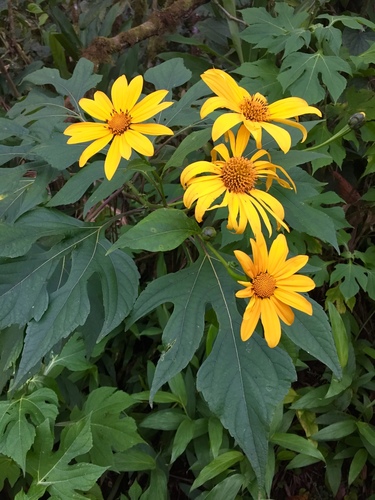
Tithonia diversifolia grows 2–3 m (6.6–9.8 ft) tall as a woody shrub with upright, sometimes ligneous stalks. Its leaves are alternate, sub-ovate, serrate, acute, 10 to 40 cm long, simply or mostly 3-7 lobed, somewhat glandular, and slightly grayish on the undersides; the alternate growth pattern of leaves gives the species its specific epithet diversifolia. The plant produces large, showy, honey-scented yellow to orange flowers that measure 5–15 cm wide and 10–30 cm long. Flowering occurs most often from April to June. Its seeds are achenes, 4-angled, 5 mm long, and dispersed by wind, water, and animals. This species was originally domesticated in Mexico, then spread to other areas of Central and South America and northward into the United States. It was introduced to parts of Africa and Asia as an ornamental plant, and has since become a widely distributed invasive weed. It is most commonly found at altitudes between 550 m and 1950 m, usually scattered along rivers and roadsides. In Asia and Latin America, the plant has regional common names: kembang bulan in Indonesian and Javanese, jalacate in Spanish, buatong in Thai, and dã quỳ in Vietnamese. Tithonia diversifolia has moderate drought tolerance. Rainfall levels in African subtropics may not be sufficient to support this species as a biomass crop, and it currently grows in humid and semi-humid areas of Africa; no attempts to grow it in desert conditions have been recorded. Tithonia diversifolia can grow in a wide range of environmental conditions, with moderate drought tolerance. It grows ideally in areas with annual rainfall between 1000–2000 mm and temperatures between 15–31 degrees Celsius, and does not require high levels of soil nutrients. As a rapidly spreading weed, it can be used as a forage crop in both grazing and cut-and-carry systems. In Japan, Tithonia diversifolia was imported as an ornamental plant towards the end of the Meiji Period, and is still seldom cultivated there. The species is rumored to have been introduced to Japan by Nitobe Inazo, leading to its Japanese common name Nitobegiku (Nitobe chrysanthemum). The plant has a characteristic bitter taste, and has been used to induce fever to help counter poisoning, though it is not used directly as a medicinal herb. It is sold in herbal medicine markets in Taiwan. It is the official city symbol of Da Lat, Vietnam, and the provincial flower of Mae Hong Son Province, Thailand. Tithonia diversifolia can be used as a green fertilizer for farmers, and also used as chicken feed, fuelwood, for soil erosion control, and for building materials. When used as fertilizer, it is made into mulch that can be spread on top of the soil or buried beneath it. Using T. diversifolia as fertilizer may increase crop yields, and can improve phosphorus utilization in soil when applied as green manure. T. diversifolia used for fertilization contains 1.76% nitrogen, 0.82% phosphorus, and 3.92% potassium; all three nutrient levels are lower than those found in cattle manure, while phosphorus levels are higher than in poultry and swine manure. In East African sugarcane fields, the flowers of T. diversifolia are used to attract beneficial arthropods as a biological control strategy.