About Tirumala septentrionis (Butler, 1874)
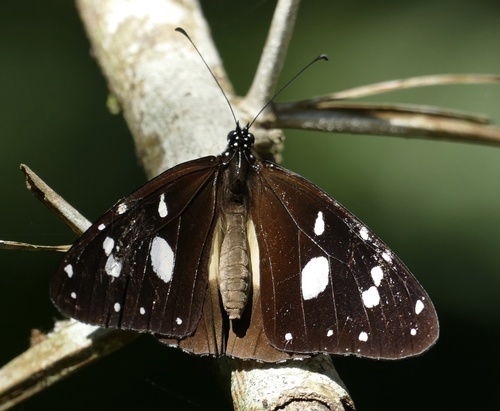
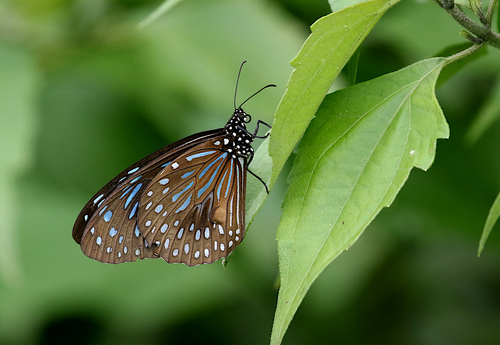
Tirumala septentrionis (Butler, 1874) has a wingspan ranging from 80–115 mm. This species closely resembles Tirumala limniace, but is distinct enough to be easily recognized, even when in flight. Wing traits of any butterfly can show strong variation rooted in genetics; for example, environmental conditions during growth can result in this species (commonly called the Dark Blue Tiger butterfly) developing a larger wingspan that supports long-distance flight. Larger wings have also been recorded in populations found at low latitudes. Compared to T. limniace, the upperside of T. septentrionis’s wings is darker, and its semihyaline markings are narrower, more distinct, and have a bluer tint. On the forewing, the two streaks in interspace 1 are narrower, never coalesce, and the upper streak forms an oval detached spot; the short streaks above vein 5 are never outwardly truncate, and are always acute at the tip. On the hindwing, the two base-united streaks in the discoidal cell are wide apart at their apices, and the lower streak never develops into a hook. On the underside, T. septentrionis is generally darker overall: the apex of the forewing and the entire ground color of the hindwing do not have the conspicuous golden brown color seen in those areas on T. limniace. This species is distributed across the Himalayas from Simla to Sikkim, extending into Assam, Myanmar, Cambodia, and the rest of Southeast Asia; it is also found in Odisha, West Bengal, southern India (including the Western Ghats and Nilgiris), and Sri Lanka. The caterpillar of T. septentrionis is similar to the caterpillar of T. limniace, as detailed in the 1896 volume x of the Journal of the Bombay Natural History Society on page 240. MacKinnon and de Nicéville recorded that caterpillars feed on Vallaris dichotoma, as noted in volume xi of the Journal of the Bombay Natural History Society (1897, page 212). Other recorded host plants for the caterpillar include Cosmostigma racemosa, Heterostemma brownii, and species in the genus Cocculus.