About Tirumala limniace (Cramer, 1775)
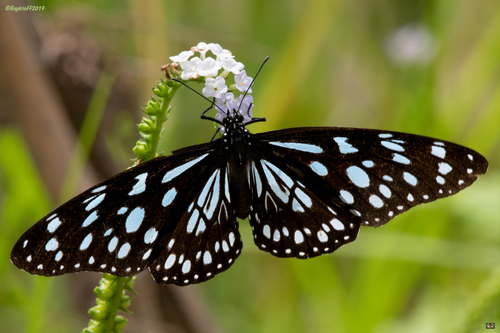
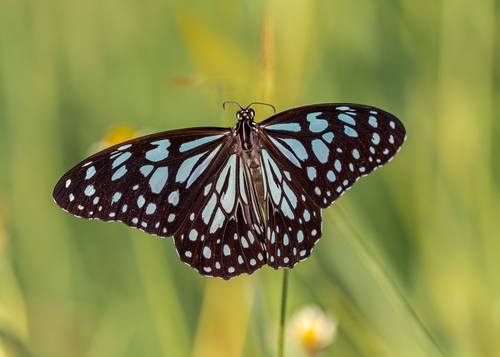
Tirumala limniace (Cramer, 1775), commonly called the blue tiger butterfly, is a small butterfly with broad wings. It has a wingspan ranging from 90 to 100 millimeters, and males are smaller than females. The upper surface of its wings is dark brown to black, patterned with bluish-white, semi-transparent spots and lines. The blue color of these bluish-white spots comes from the pigment pterobilin. Like all butterflies, this species can directly absorb heat from the sun through its wings to enable independent flight. Studies on blue tiger butterflies show that high-intensity light significantly increases their flight activity. Their wing surfaces have a mix of light and dark colors, and the dark wing areas act as heat absorption regions that facilitate autonomous flight. On the forewing, cell 1b (an area of the wing bounded by veins, like all other wing cells) contains two strips, which are sometimes connected, followed by a large spot. A stripe runs from the base of the discoid cell, followed by a large spot notched towards the wing tip (apex). A large oval spot is located at the base of cell 2, while a much smaller spot sits at the base of cell 3, and an additional small spot follows it. On the leading edge of the post-disk region, there are five short stripes, only two of which are clearly defined. Two rows of irregular points run submarginally, and the inner points are larger than the outer points. On the upper side of the hind wing, cell 1a contains a stripe. A strip branching from the base also runs through cells 1b and 1c. The discoid cell has a wide dividing strip, and the lower branch has a hooked shape or a short spur-like base. At the base of cells 2 and 3, there is a thin, V-shaped arch. Cells 2 and 5 each have a strong, wide stripe at their base. Two rows of scattered, irregular points also run submarginally on the hind wing, with the inner points larger than the outer points. Males can be distinguished from females by a black pocket filled with scented scales in cell 1c, near the discoid cell on the upper side of the hind wings. These pockets form only after hatching, when the newly emerged butterfly inflates its wings by folding scented scales. The pockets, along with eversible hair tufts on the abdomen, play an important role in courtship. The hairs grow almost exclusively from the rear third of the hair tuft, which is a typical feature of Danaini genera grouped in the clade Danaina. The underside of the forewing is black; only the apex is olive-brown, and the entire underside of the hind wing is also olive-brown. The pattern on the underside of the wings largely matches the pattern on the upper side. The antennae, head, and thorax are all black; the head and thorax also have white dots and white lines. The upper side of the abdomen is dark, while the underside is pale brownish yellow, with a white sheen along the segment boundaries. This species is native to South Asia and Southeast Asia. In 2019, a single adult specimen was reported from the Balearic Islands, marking the first recorded occurrence of this species in Europe. The larvae of this butterfly generally feed on plants in the family Asclepiadaceae. Recorded host plants include species from the genera Asclepias, Calotropis, Crotalaria, Epibaterium, plus Glycine max, Heterostemma cuspidatum, Hoya viridiflora, Marsdenia tenacissima, and Wattakaka volubilis (synonym Drega volubilis).