About Tirumala hamata (MacLeay, 1826)
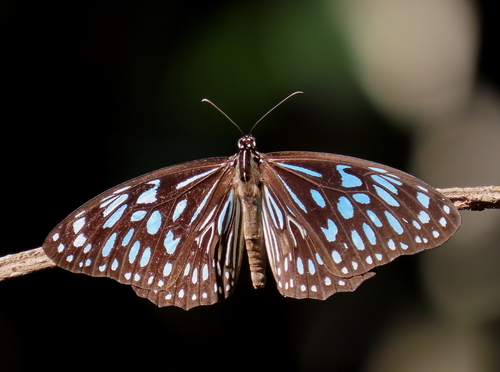
Tirumala hamata, commonly known as the dark tiger, is a butterfly species belonging to the family Nymphalidae. This species is distributed across the region ranging from the Philippines to Australia, as well as on oceanic Pacific islands including Samoa. In Australia, adult dark tiger butterflies carry out mass southward migrations in certain years. In April 1995, the species completed an unusual migratory trip to New Zealand, an event that happened at the same time that Hypolimnas bolina butterflies also appeared on the New Zealand islands. The wingspan of adult Tirumala hamata is approximately 70 millimeters. Adult individuals have black wings marked with blue spots. Their bodies are grey, with black bands between body segments, orange lateral lines, and a black head marked with white patterns. Adult dark tiger butterflies have been observed scratching the leaves of Heliotropium amplexicaule and Parsonsia straminea; this behavior may be done to access moisture, or to collect pyrrolizidine alkaloids used for pheromone production, chemical defense, or both. The larvae of Tirumala hamata feed on a broad variety of host plants. These include plants in the genus Parsonsia (specifically Parsonsia straminea and Parsonsia velutina), Heterostemma papuana, Heterostemma acuminatum, Hoya australis, plants in the genus Leichhardtia, plants in the genus Marsdenia (specifically Marsdenia velutina), Secanome carnosum, Secamone elliptica, plants in the genus Vincetoxicum (synonym Tylophora), Cryptostegia grandiflora, Cynanchum carnosum, and Cynanchum leptolepis.