About Tiracola plagiata (Walker, 1857)
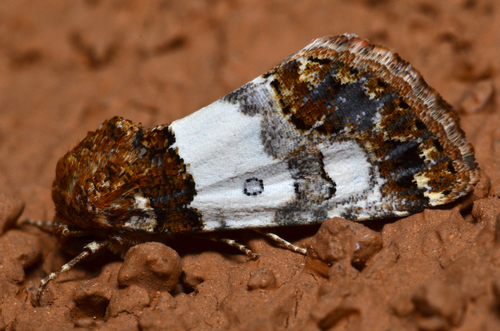
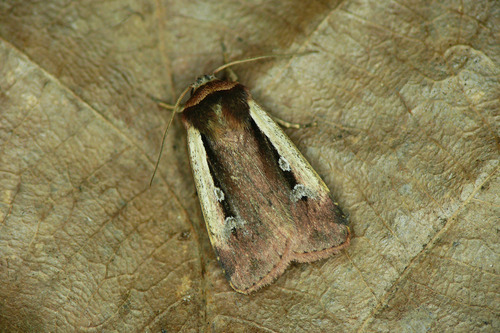
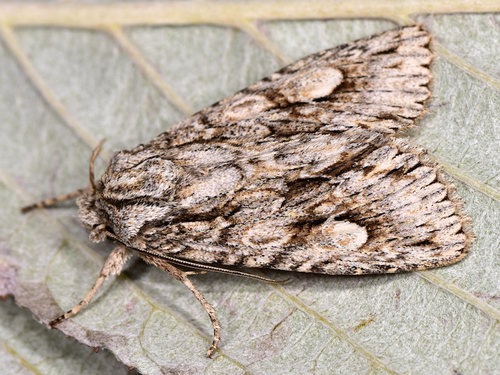
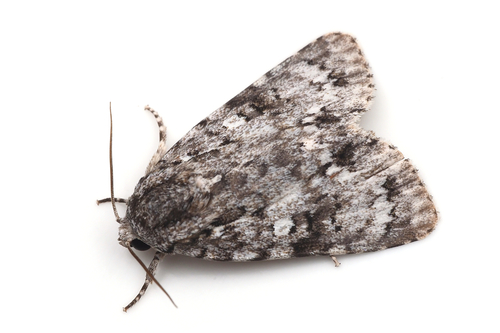
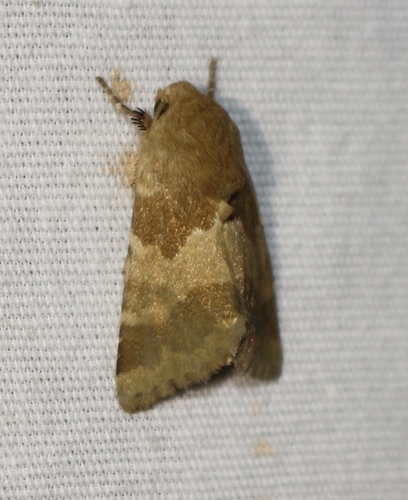
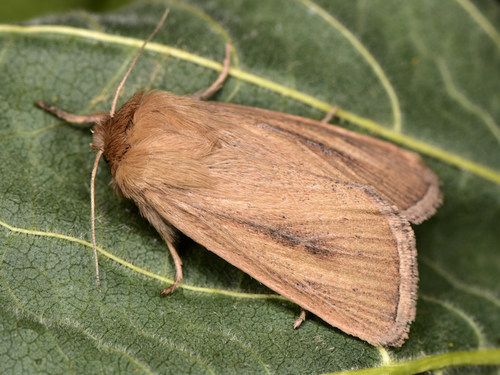
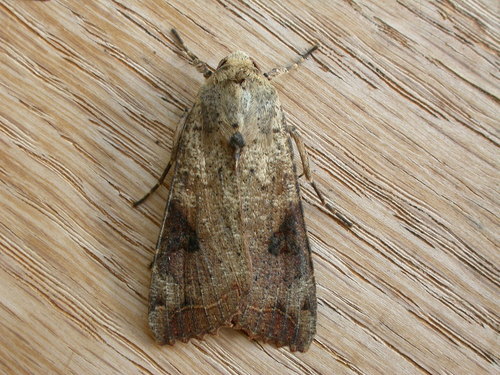
This species, Tiracola plagiata (Walker, 1857), has a wingspan of approximately 60 mm. Male antennae are minutely ciliated, and the cilia on the forewings are strongly toothed. The body is pale greyish brown, while the abdomen is fuscous. Forewings are often suffused with red brown and sprinkled with dark brown. An indistinct, waved antemedial line is present, and is often obsolete. The orbicular spot is also obsolete, while the reniform spot is almost obsolete, and is colored ochreous or fuscous; it sometimes sits on a dark patch. There are traces of a postmedial curved series of black specks. A submarginal doubly curved ochreous line can be seen, and this is accompanied by a marginal series of black specks. The hindwings are fuscous, and have whitish cilia. The larva is dull violet brown with a small number of fine dorsal hairs. It has a few scattered grey dots and a sub-lateral pale olivaceous band that runs starting from the fourth somite. The head and legs are violet grey; the head is small, and the anal somite is conical. The pupa is dark red. Ecologically, Tiracola plagiata is an international fruit pest, with a particular preference for Musa acuminata, a banana species. Larvae have also been recorded feeding on other host plants: Dioscorea species, Diplocyclos palmatus, Toona australis, Eucalyptus, Portulaca oleracea, Phytolacca octandra, Theobroma cacao, Coffea arabica, and Physalis ixocarpa.