About Tipularia discolor (Pursh) Nutt.
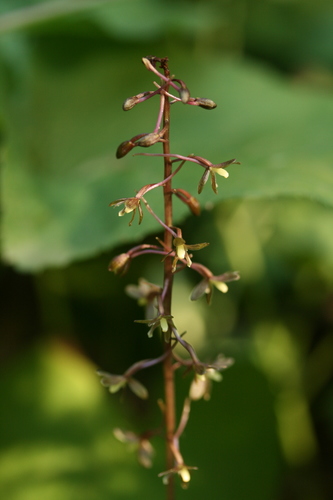
Tipularia discolor (Pursh) Nutt. is an orchid that has a reddish brown stem and dull yellow to purplish brown, weakly monosymmetric flowers. Its leaves are easily identifiable: they are ovate, with a bright green upper (adaxial) surface and a purple lower (abaxial) surface. A single leaf emerges in autumn and persists through the winter. By late spring to early summer, all leaves fall off, and the orchid begins to bloom. No new leaves grow while the plant is flowering, which occurs from June to September. The erect flowering stalk grows between 10 and 65 cm tall. The stem is herbaceous, glabrous, and leafless. Each individual T. discolor can grow 2 to 5 subterranean corms. This is one of the most common orchid species in North America. It occurs across most of the southeastern United States, with a range extending from Texas to Florida and north to New Jersey, and is rare or endangered in some central states. Isolated populations exist in New York and Ohio. It grows in deciduous forests, and requires humus-rich soils formed from decaying tree matter to germinate and develop. The corms of T. discolor hold a large concentration of non-structural carbohydrates, which supply energy for new growth and reproductive processes. This species can tolerate dry, acidic soil. T. discolor depends heavily on mycorrhizal fungi during its early developmental stages, because its seeds are small and nearly dust-like, too small to store enough food reserves for proper development. Mycorrhizal fungi live in the species' protocorm to support germination. A recent study found that these fungi persist in the protocorm even after the plant matures and reduces its reliance on the symbionts.