About Tinospora cordifolia (Willd.) Miers
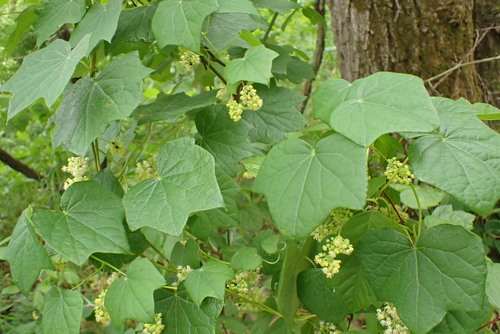
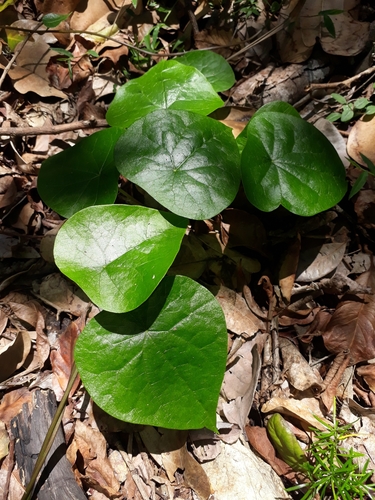
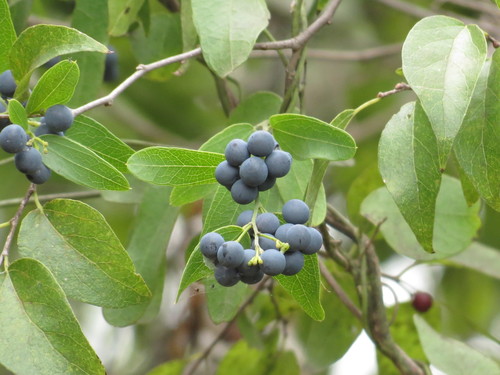
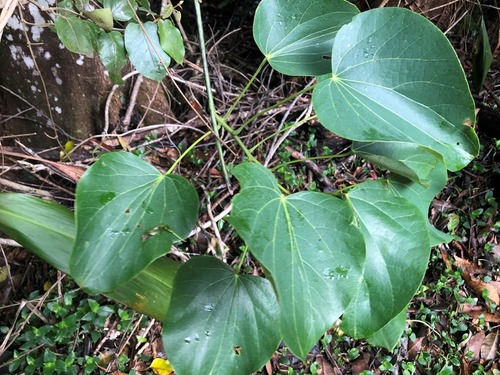
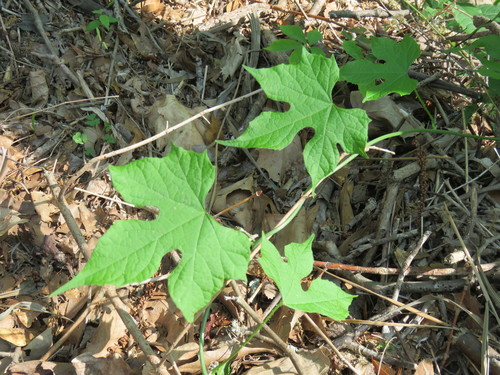
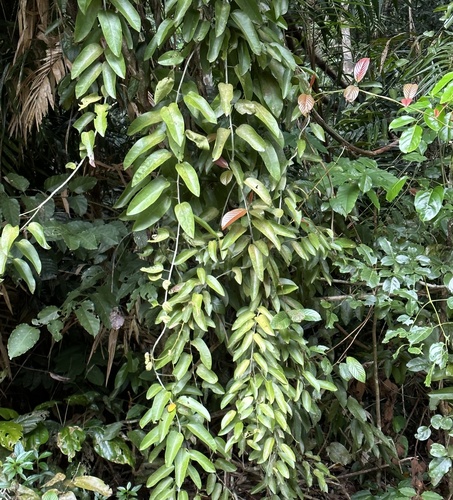
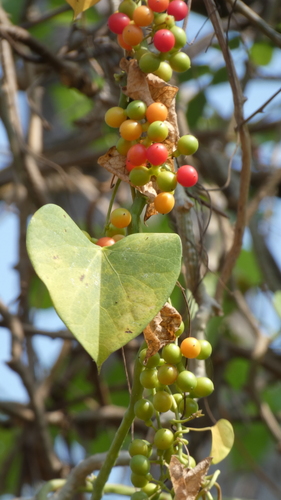
Tinospora cordifolia (Willd.) Miers, commonly called heart-leaved moonseed, gets this common name from its heart-shaped leaves and reddish fruit. It is a large, deciduous, extensively spreading climbing vine with multiple elongated twining branches. Its leaves are simple, alternate, and exstipulate, with long petioles that reach up to 15 cm (6 inches) long. The petioles are roundish and pulvinate at both the base and apex; the basal pulvinus is longer and partially twisted halfway around the petiole. The leaf blades are broadly ovate or ovate cordate, 10–20 cm (4–8 inches) long and 8–15 cm (3–6 inches) wide. They are seven-nerved, deeply cordate at the base, and membranous, with pubescence on the upper surface, and whitish tomentose covering with a prominent reticulum on the lower surface. Flowers are unisexual, small, and borne on separate individual plants. They emerge when the plant has no leaves, are greenish-yellow, and grow on axillary and terminal racemes. Male flowers grow in clusters, while female flowers are usually solitary. Each flower has six sepals arranged in two series of three, with outer sepals smaller than the inner sepals. It also has six petals that are smaller than the sepals, obovate, and membranous. Fruits form aggregated clusters of one to three drupelets. These drupelets are ovoid and smooth, borne on thick stalks, have subterminal style scars, and are scarlet or orange in colour. Endophytic fungi colonize the living internal tissues of this plant without causing harmful effects. One recent study found 29 endophytes from different taxonomic groups in samples collected from Tinospora cordifolia. Tinospora cordifolia has been used for centuries in Ayurvedic traditional medicine based on the belief that it has medicinal properties. However, reviews of clinical research have found no evidence to confirm that Tinospora cordifolia produces any medicinal effect.