About Tinnea rhodesiana S.Moore
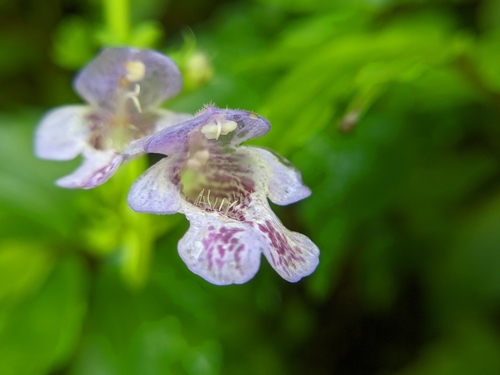
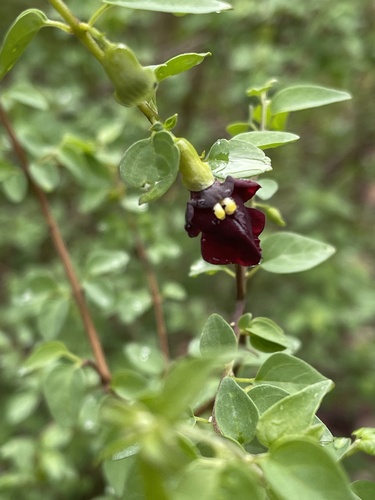
Tinnea rhodesiana S.Moore is a twiggy, soft shrub that typically grows 0.6 to 2.5 m (2 ft 0 in to 8 ft 2 in) tall. Young branches are pale brown and finely hairy, and they usually become smoother as the plant ages. Its leaves grow on short stalks, have a somewhat leathery texture, and range in shape from ovate to ovate-lanceolate. Most leaves are 8 to 20 mm (0.31 to 0.79 in) long, though they may occasionally reach 30 mm (1.2 in). Leaves are darker green on the upper surface and paler underneath, with small glandular dots on the lower surface and smooth edges. Flowers form a loose inflorescence 50 to 100 mm (2.0 to 3.9 in) long at the tips of branches and short side shoots, usually with one or two flowers per whorl. The corolla is chocolate-brown to purplish, smells of violets, measures 14 to 18 mm (0.55 to 0.71 in) long, and has a broad, three-lobed lower lip. After flowering, the calyx expands as the fruit develops into an inflated, straw-coloured, ovoid structure 12 to 18 mm (0.47 to 0.71 in) long. The fruit is made up of nutlets 5 to 7 mm (0.20 to 0.28 in) long, each with a broadly elliptical wing around 8 mm × 6 mm (0.31 in × 0.24 in) in size. Tinnea rhodesiana can be distinguished from the related species Tinnea galpinii by its taller, more upright, more twiggy growth habit, and by its flowers typically growing singly on short lateral shoots instead of in terminal clusters. It can be told apart from Tinnea aethiopica by its pubescent nutlets and the smooth, cylindrical shape of its branches. This species grows on stony hillsides in dry, open woodland in Angola, Zambia, Botswana, Zimbabwe, Mozambique, northern Namibia, and the Limpopo and Mpumalanga provinces of South Africa.