About Tilia cordata Mill.
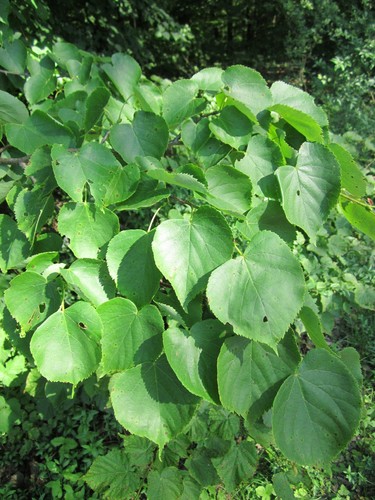
Tilia cordata Mill. is a deciduous tree that grows 20–40 m (66–131 ft) tall, with a trunk diameter up to 1 m (3 ft), and a trunk diameter that is one-third to one-half the tree's total height. The largest known specimen, located in Närke, Sweden, has a trunk circumference of 8.35 metres (27.4 ft) measured at chest height. Some lime trees in Germany are reported to be over 1000 years old. Young bark is smooth and grayish; older bark is firm, marked by vertical ridges and horizontal fissures. The crown ranges from a regular rounded oval shape to pyramidal. Branching grows upright and becomes denser as the tree ages. Leaves are alternately arranged, rounded to triangular-ovate, 3–8 cm (1.2–3.1 in) long and wide, and distinctively heart-shaped. Unlike the related Tilia platyphyllos, Tilia cordata leaves are mostly hairless, except for small tufts of brown hair in the leaf vein axils. Buds are alternate, pointed egg-shaped with red scales, and the tree does not produce a terminal bud. The small yellow-green hermaphrodite flowers grow in clusters of five to eleven in early summer, with a leafy yellow-green subtending bract, and have a rich, heavy scent. Bees frequently visit these trees; Tilia cordata flowers are held erect above the bract, which distinguishes this species from Common Lime (Tilia × europaea), where flowers grow beneath the bract. The fruit is a dry nut-like drupe, 6–7 mm long by 4 mm wide, containing 1-2 brown seeds, while infertile fruits are globose. Fruits are downy when young and become smooth at maturity. Unlike fruits of T. platyphyllos and T. × europaea, Tilia cordata fruits are not ribbed, have very thin walls, and crack open easily. Regarding ecology, Tilia cordata favors good, loamy sites, but can also grow on sandy, infertile soils, and is not considered drought resistant. Dormant shoots of Tilia cordata can tolerate winter frost temperatures as low as −34 °C (−29 °F). In Britain, where Tilia cordata is traditionally called pry, it is considered an indicator of ancient woodland and is becoming increasingly rare. Due to its rarity, a number of woods where it grows have been given SSSI status. Cocklode Wood, part of the Bardney Limewoods in Lincolnshire, is the best surviving extent of medieval small-leaved limes in England. Shrawley Wood in Worcestershire is another notable site. Historically, small-leaved lime was regarded as holy and considered good for carving. Trees in northern England established when the climate was warmer and have since adapted to a cooler climate. Paleobotanical analysis of tree pollen preserved in peat deposits shows Tilia cordata was present as a woodland tree in the southern Lake District around 3100 B.C. Even though T. cordata migrated into the Lake District relatively late, pollen diagrams from many sites show it expanded rapidly, becoming plentiful and even locally dominant in southern valleys within a few centuries. Maximum Tilia pollen values from all available pollen diagrams for northern England show a clear concentration of high values in the southern Lake District. At several sites among the limestone hills on both sides of the estuary of the River Kent, Tilia pollen curves begin between 4800 and 4000 B.C., and reach values of at least 10% within a few centuries. At Witherslack in Cumbria, pollen values of this magnitude persist through a 3 m (10 ft) depth of deposit, which represents about 4000 years. For much of this period, Ulmus pollen makes up approximately 10%, Quercus 20%, and the remaining arboreal pollen is largely Alnus. For a shorter period, Tilia pollen exceeds Quercus and reaches a maximum of 30%. The Witherslack basin is about 200 m (660 ft) in width, so after applying distance correction factors, this indicates that surrounding woodlands on well-drained soils contained Tilia, Quercus and Ulmus in the proportion 4 : 1 : 1. Modern mature woodland trees are estimated to have germinated between 1150 and 1300 AD, making them around 800 years old. Precise age determination is impossible because the central heartwood disintegrates, so tree rings cannot be counted, and other age estimation methods are used. For cultivation and uses, Tilia cordata is widely grown as an ornamental tree. It was heavily planted to form avenues during 17th and early 18th century landscape planning; a famous example is Unter den Linden in Berlin. It is also widely cultivated in North America as a substitute for the native Tilia americana (American linden or basswood), which has larger, coarser-textured leaves; in North America, it is commonly called "Little-leaf Linden". It is popular as a shade tree for its dense canopy, as an ornamental tree for its structured architectural shape, and as a street tree. In the US, Tilia cordata has been planted as a street tree in Wellesley, MA; Modesto, CA; Chicago, IL; Indianapolis, IN; and Atlanta, GA. In Europe, it is often grown as espaliered trees because it survives heavy pruning well. Tilia cordata is easy to train for bonsai when training is not completed all at once; letting the tree recover between training sessions over several months produces a healthy, attractive miniature tree. Before firearms were invented, it was also commonly used to make shields, as referenced in Beowulf. Tilia cordata grows best in a soil pH range of 5.0 to 8.0, and in USDA Hardiness Zones 3–7. The tree prefers moist, well drained soil, but can survive flooding; it is not highly drought tolerant, and does not grow well in soils with high salinity.