About Tigrosa helluo (Walckenaer, 1837)
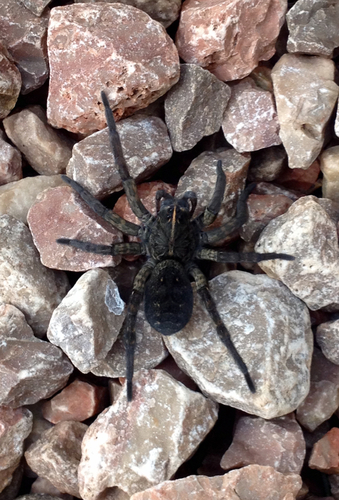
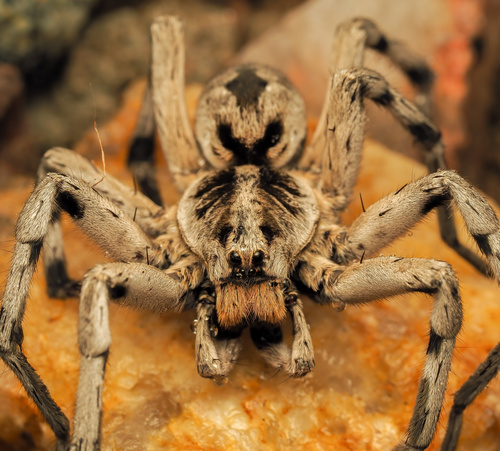
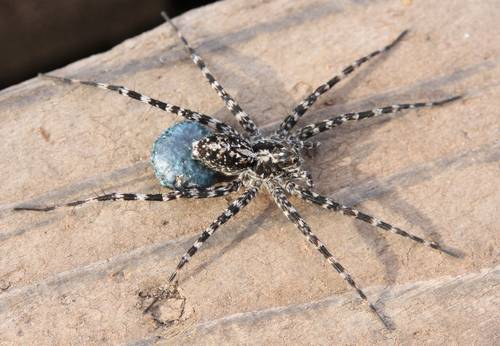
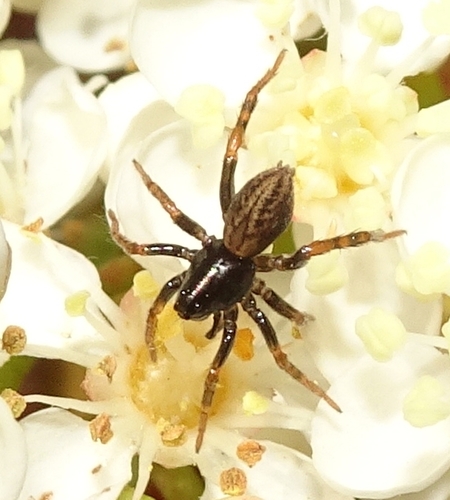
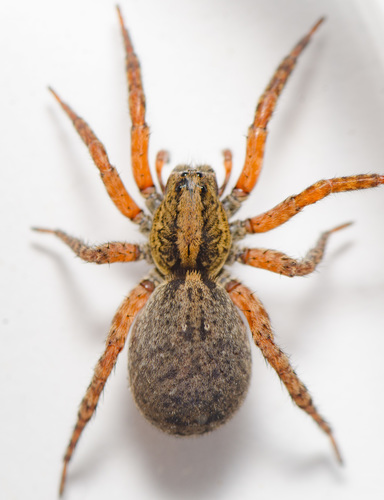
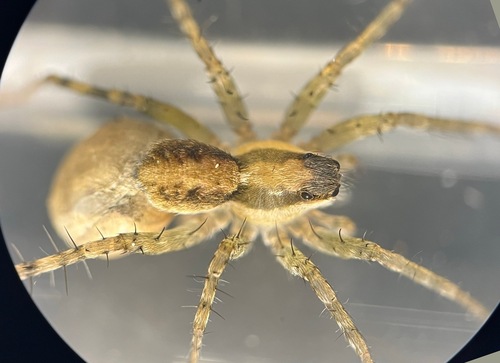
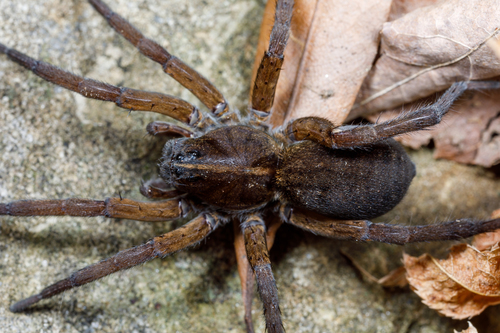
Within the genus Tigrosa, average body lengths range from 10 to 31 mm (0.39 to 1.22 in) for females and 11 to 24 mm (0.43 to 0.94 in) for males, while the average body length of Tigrosa helluo is 17 mm (0.67 in). Compared to its close relative Tigrosa aspersa, T. helluo is much smaller. It is also often mistaken for the nursery web spider Pisaurina mira due to physical resemblance. T. helluo can be distinguished by its brownish carapace, which features a distinctive yellow stripe that runs from the anterior eyes to the cephalothorax. A pair of fainter yellow stripes extends posteriorly starting from the posterior median eyes. The underside of the abdomen has several distinct black spots. Patterns on the dorsal side of the cephalothorax and abdomen are similar to those of Tigrosa georgicola, but the faint yellow stripes of T. helluo do not extend as far, and T. georgicola lacks the black abdominal spots found on T. helluo. Leg color differs between sexes: males have unmarked yellow legs, while females have unmarked, unbanded reddish brown legs. In the United States, T. helluo occurs across a wide range of states, and inhabits woods, marshes, and grassy areas in northeastern states including Connecticut. Female nests are typically located under stones or boards in fields and woods, and are structured as silk-lined burrows. In states like Florida and Mississippi, T. helluo is most often found in wetter habitats such as marshes and lakes. This species is distributed across the United States, Canada, and Mexico. It primarily occurs along the East Coast in the New England region, and can be found along the entire East Coast down to Florida. It lives in most states in the eastern half of the United States, with a western range extending as far as Kansas and Nebraska. Mating for T. helluo usually takes place in May or June. Males live just over one year, while females typically live around two years. Males reach maturity between May and September. Females produce egg sacs between May and July; these egg sacs range from 8 to 12 mm (0.31 to 0.47 in) in diameter. The eggs themselves are tan or yellow, and measure around 1 to 2 mm (0.04 to 0.08 in) in diameter. Females carry the egg sac on their back until the eggs hatch, and continue to carry the newly hatched spiderlings on their back after hatching until the young are mature enough to hunt independently. Females can reach maturity at any time of year. Once mature, females overwinter during cold months, while males typically die before cold weather sets in. As T. helluo matures, it molts periodically. The timing and duration of molting depends on nutritional intake and the resulting growth potential. Molting frequency is based on an individual's nutritional reserves, and individuals that feed more often molt less frequently during maturation.