About Tichodroma muraria (Linnaeus, 1766)
Size and Weight
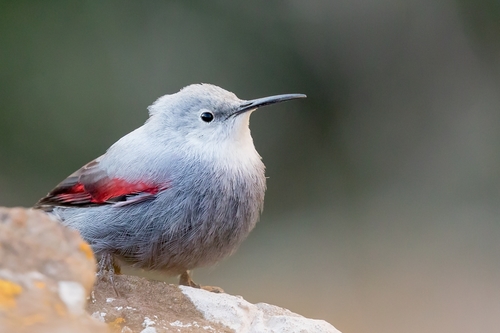
The wallcreeper (Tichodroma muraria) measures 15.5–17 centimetres (6.1–6.7 in) in length, and weighs 17–19 grams (0.60–0.67 oz).
Basal Plumage Coloration
Its plumage is mostly blue-grey, with darker flight and tail feathers.
Breeding Season Throat Plumage
In summer, breeding males have a black throat that blends into the grey of the rest of the body. Females in summer may have either a white throat, or a small dark patch on the throat.
Non-breeding Throat Plumage
In autumn and winter, both sexes have a white throat.
Wing Plumage
The most striking feature of this bird's plumage is its extraordinary crimson wings marked with white spots. This bright coloration, which is mostly hidden when the wings are folded, covers most of the covert feathers, and the basal half of the primaries and secondaries.
Tail Characteristics
The wallcreeper has a short, black tail with a narrow white fringe.
Juvenile Plumage
Juvenile wallcreepers closely resemble the winter plumage of adults.
Subspecies Variation
The subspecies T. m. nepalensis is slightly darker than the nominate subspecies.
Habitat Type
The wallcreeper is a high mountain bird.
Breeding Elevation Range
Its breeding elevation ranges from 1,000 to 3,000 metres (3,300 to 9,800 ft) in Europe, 2,800 to 4,000 metres (9,200 to 13,100 ft) in the Tien Shan, and 3,600 to 5,100 metres (11,800 to 16,700 ft) in the Himalaya.
General Winter Movement
It is largely resident across its range, but moves to lower elevations in winter, where it can be found on buildings and in quarries.
Winter Sightings in France
In France, wallcreepers regularly and repeatedly winter on cathedrals and viaducts in Brittany and Normandy.
Vagrant Winter Records
Some individuals have wintered as far from their core range as England and the Netherlands; one individual spent two consecutive winters between 1989 and 1991 at Vrije Universiteit in Amsterdam.
South Asian Distribution
The species is resident across much of the Himalayas, ranging through India, Nepal, Bhutan, and parts of Tibet, and occurs as a winter visitor in Bangladesh.
Cryptic Behavior
Wallcreepers can be quite tame, but are often surprisingly difficult to spot on mountain faces. While they may be confiding in both breeding and non-breeding seasons, and vagrant individuals are especially extremely tame, they will hide when they know they are being watched.
Nesting Avoidance Behavior
They hesitate before entering their nests, and may even take roundabout routes to the nest when observed for long periods of time.
Breeding Territoriality
Wallcreepers are territorial. Pairs vigorously defend their breeding territory during the summer.
Winter Territoriality
During winter, the wallcreeper is solitary, with males and females each defending individual feeding territories. The size of these feeding territories is hard to estimate, but a territory may consist of a single large quarry or rock massif, or a series of smaller quarries and rock faces.
Winter Territory Movement
Wallcreepers may travel some distance from roosting sites to their feeding territories. They have been recorded showing site fidelity to winter feeding territories across consecutive years.


