About Tiaris olivaceus (Linnaeus, 1766)
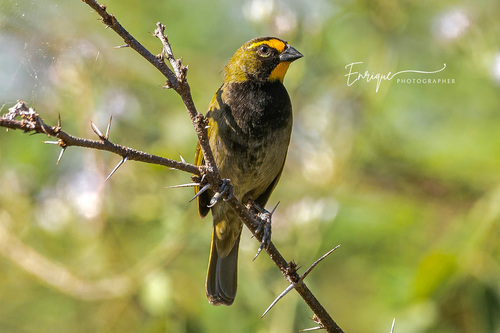
This small bird species, Tiaris olivaceus, has a conical bill that is sharper than the bill of its close relatives, the seedeaters. It measures 10 to 10.7 cm (3.9 to 4.2 inches) long and weighs around 8 to 10 grams (0.28 to 0.35 ounces), with size varying by subspecies. Adult males have an olive-green back; their face and breast are black, with the exception of a bright yellow throat, supercilia, and lower eyelid spot. The rest of their underparts are greyish olive. Their beak and eyes are dark, and their legs are grey. Adult females are slightly smaller on average than males. They are dull olive-green on their upperparts and paler grey on their underparts, and may have dark smudges on the breast. Their yellow face pattern is much weaker and duller, and may be almost completely invisible. The lower section of their beak is dark horn-colored, a pale light grey shade. Young birds have essentially the same coloration as adult females, but are duller and greyer overall. Young males begin to develop their full adult plumage during their first year of life. This species breeds across a range that extends from central Mexico to northern Ecuador and north-western Venezuela, and is also found in the Greater Antilles and the islands nearby. It is not migratory, though it moves around outside the breeding season; vagrant individuals have been recorded in southern Texas and Florida, and the species has been introduced to Hawaii. The yellow-faced grassquit is a common to abundant resident of lowlands and foothills up to 2,300 m (7,500 ft) in altitude, inhabiting semi-open areas including roadsides, pasture, weedy fields, and low scrub. It avoids dry grassland and other very low-growing plant cover, but readily uses neglected gardens where lawn grass has grown tall. It is a fairly sociable bird, and sometimes forms loose flocks with other tanagers, including seedeaters, and emberizids that share its habits. Occasionally, groups of adult males will gather to perch in a shrub and sing.