About Tiarella stolonifera G.L.Nesom
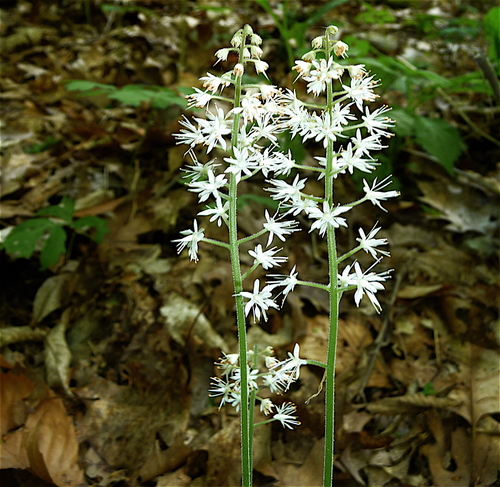
Tiarella stolonifera G.L.Nesom is a perennial herbaceous plant with a short, slender rhizome. It produces a leafless flowering stem and relatively small basal leaves that lack an extended terminal lobe. Its defining characteristic is its ability to produce stolons. The heart-shaped basal leaves of this species resemble leaves of species from other genera, and it is sometimes confused with Mitella diphylla, a close relative that shares a similar range and habitat. When a plant does not show clear evidence of flowering, the orientation of hairs on its basal leaf stalk can be used to distinguish the two species. Tiarella stolonifera has dense spreading outward-facing hairs that angle approximately 90 degrees from the stalk, and these hairs come in a range of lengths. In comparison, Mitella diphylla has long backward-facing retrorse hairs that angle 45 degrees or less from the stalk, and these hairs are sparsely distributed along the stalk.
To positively identify Tiarella stolonifera, all of the following key features must be verified, in any order: presence of a stolon, basal leaves that are usually about as long as they are wide, basal leaf lobes that are usually obtuse to rounded with no extended terminal lobe, and a flowering stem that has no leaves or foliaceous bracts. These key features are similar to those of Tiarella cordifolia, but the presence of a stolon rules out Tiarella cordifolia.
Tiarella stolonifera has the widest distribution of any Tiarella species in eastern North America. Its range stretches from Wisconsin across the eastern half of the Great Lakes region into the northeastern United States and adjacent Canada, and extends south into Kentucky, Virginia, Tennessee, and North Carolina. It is the only Tiarella species present in 17 provinces and states: the Canadian provinces of New Brunswick, Nova Scotia, Ontario, Québec; and the U.S. states of Connecticut, Maine, Massachusetts, Michigan, New Hampshire, New Jersey, New York, Ohio, Pennsylvania, Rhode Island, Vermont, West Virginia, Wisconsin. Tiarella stolonifera occurs alongside at least one other Tiarella species in five additional U.S. states, with occurrences documented in the following counties: Kentucky: Bell, Carter, Clay, Elliot, Estill, Floyd, Gallatin, Garrard, Greenup, Harlan, Jackson, Jessamine, Jefferson, Johnson, Kenton, Knott, Knox, Laurel, Lee, Leslie, Letcher, Lincoln, Madison, Martin, McCreary, Menifee, Perry, Pike, Powell, Pulaski, Rockcastle, Rowan, Whitley, Wolfe, Woodford Maryland: Allegany, Garrett, Harford, Washington North Carolina: Alleghany, Ashe, Avery, Buncombe, Burke, Madison, McDowell, Mitchell, Watauga, Wilkes, Yancy Tennessee: Anderson, Campbell, Carter, Claiborne, Grainger, Greene, Hancock, Hawkins, Knox, Morgan, Roane, Scott, Unicoi, Union, Washington Virginia: Bath, Bland, Buchanan, Carroll, Dickenson, Floyd, Giles, Grayson, Highland, Pulaski, Rockbridge, Rockingham, Russell, Scott, Smyth, Tazewell, Washington, Wise, Wythe
The ranges of Tiarella stolonifera and Tiarella wherryi overlap in Laurel, McCreary, and Pulaski counties, Kentucky, and in Anderson, Campbell, Knox, Morgan, Roane, and Scott counties, Tennessee. The ranges of Tiarella stolonifera and Tiarella cordifolia sensu stricto overlap in Alleghany, Avery, Burke, McDowell, and Wilkes counties in western North Carolina. Both Tiarella stolonifera and Tiarella austrina occur in Buncombe County, North Carolina.
Tiarella stolonifera typically grows in moist, rich deciduous woods with a fairly open understory, in partial to full shade. Tree species associated with this plant include sugar maple (Acer saccharum), white ash (Fraxinus americana), yellow birch (Betula alleghaniensis), American beech (Fagus grandifolia), eastern hemlock (Tsuga canadensis), and northern white-cedar (Thuja occidentalis). In Wisconsin, Tiarella stolonifera grows in mature second-growth sugar maple-beech or hemlock-hardwood forests with sparse shrub layers. In its typical streamside habitat, soil is very moist due to a high water table, and the ground flora is rich with spring ephemerals and other herbaceous species, including Dicentra, Cardamine, Viola, and Mitella diphylla. In Michigan, it is found in deciduous and mixed woods, most often in wet hollows or springy locations. In the Adirondack Mountains of New York, it commonly grows on low-acidic sites under northern hardwoods, and also occurs along brooks in coniferous forests where organic acids do not accumulate readily. In the White Mountain National Forest in New Hampshire, it grows in dense colonies at the edges of seeps and ephemeral streams. It was probably an important component of the ground flora in at least some parts of the original hemlock-white pine-northern hardwoods forest of New England. In New Brunswick and Nova Scotia, it grows on fairly strong calcareous soils where seepage water reaches the surface. In New Brunswick, it is most often found in habitats dominated by Thuja, particularly on valley slopes and creek valley floors. In southern Ontario, it typically grows in higher-quality cedar seepage swamps and cedar-dominated riparian habitats.