About Thysanotus manglesianus Kunth
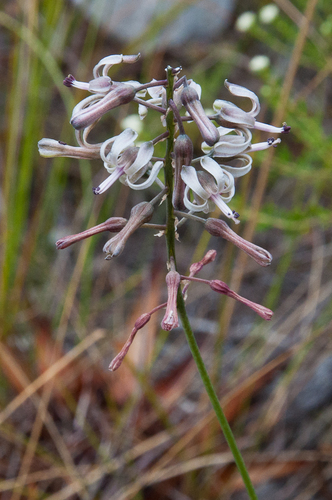
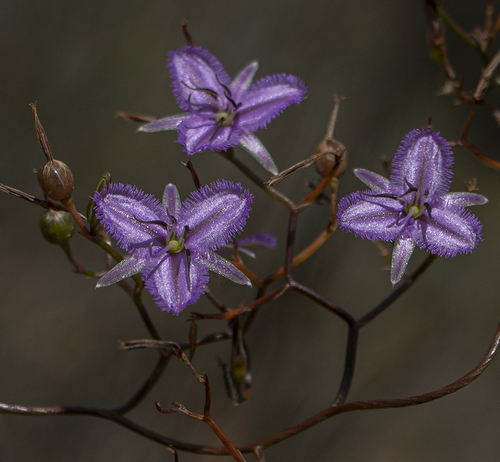
Thysanotus manglesianus (common name Mangles' fringed lily) is a twining perennial herb with a small rootstock and tuberous roots. It produces leaves very infrequently, growing only one or two terete leaves that measure 100–200 mm (3.9–7.9 in) in length. Its flowering stem is produced annually, is leafless, and only has hairs at its base. The stem is typically 10–100 cm (corrected measurement for clarity, original source incorrectly marked 10–100 m) long, and it either twines around other vegetation or grows prostrate, usually with many dichotomous branches. Flowers are borne singly on the branches, each on a pedicel 2–5 mm (0.079–0.197 in) long. The flowers are purple, with perianth segments 10.5–16 mm (0.41–0.63 in) long. The sepals are linear and 2.5–3.0 mm (0.098–0.118 in) wide. The petals are elliptic, around 6 mm (0.24 in) wide, with a fringe roughly 2.5 mm (0.098 in) long. There are six stamens: the outer anthers are around 4 mm (0.16 in) long, while the inner anthers are around 6 mm (0.24 in) long and curved. The style measures approximately 7–8 mm (0.28–0.31 in) long. Flowering occurs from August to November. The seeds are roughly spherical, around 1.5 mm (0.059 in) in diameter, and have a straw-coloured aril. This species grows in sand, loam, or laterite, and can also be found on granite outcrops in sandplain, mallee, and forest habitats. It is widespread across the Avon Wheatbelt, Carnarvon, Coolgardie, Esperance Plains, Gascoyne, Geraldton Sandplains, Great Victoria Desert, Jarrah Forest, Little Sandy Desert, Mallee, Murchison, Pilbara, Swan Coastal Plain, Warren, and Yalgoo bioregions of Western Australia.