About Thysanoplusia orichalcea (Fabricius, 1775)
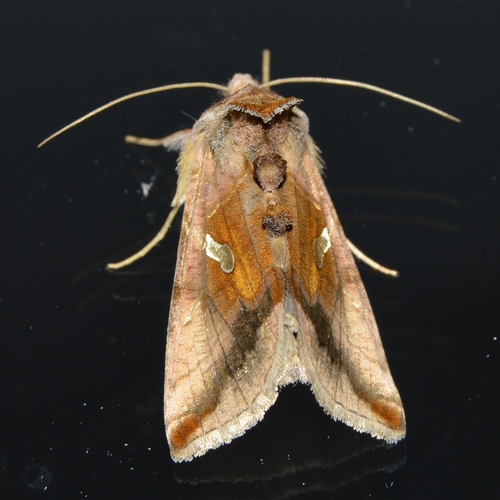
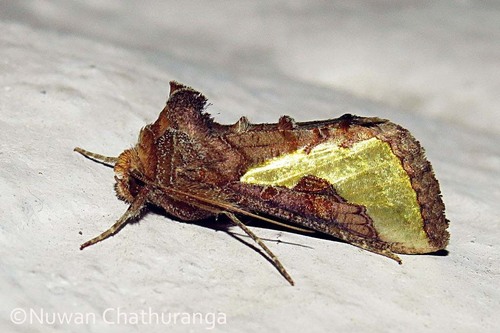
This species has a wingspan of 36–44 mm. Its head, collar, and the vertex of the head are reddish orange. Tegulae and forewings are pale reddish brown. The forewings are extensively covered with a metallic golden shimmering surface; only the costal field and fringe are brown. The sub-basal, antemedial, and postmedial waved lines are very indistinct, fine, and whitish in colour. The sub-marginal line is irregularly lunulate. The reniform and orbicular spots are small and white-bordered. The unpatterned hindwings are grey brown, and somewhat darker along the margin. The thorax is furry with some hair tufts, and the proboscis is well developed. Larvae are bluish green with a few short dorsal hairs, slender dorsal white lines, and a prominent lateral line. In ecology, the moth flies from August to October, with timing varying by location. The larvae feed on a variety of herbaceous plants, including crop species such as sunflower, Coreopsis, potato, and soybean. For population management, phenylacetaldehyde — a volatile floral compound that attracts many Lepidoptera, and that occurs naturally in Canada thistle (Cirsium arvense) — has been found to be effective for trapping this species, especially females.