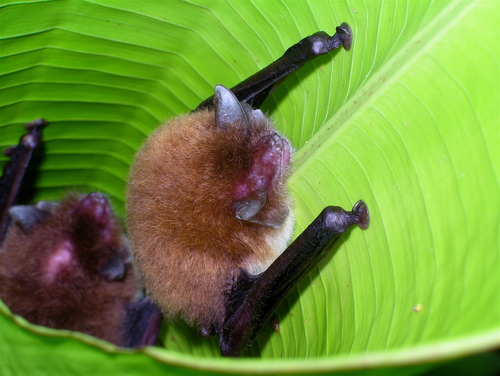
About Thyroptera tricolor Spix, 1823
Coloration
Spix's disk-winged bat, Thyroptera tricolor, has a white or pale yellow underbelly and a dorsal surface ranging from reddish-brown to black.
Forearm Length
In one survey of the species, females had an average forearm length of 37 millimetres (1.5 in), and males had an average forearm length of 36 millimetres (1.4 in).
Weight
Adults weigh around 4 grams (0.14 oz).
Roosting Posture
Unlike most bats, T. tricolor clings head-up to its roost.
Head-up Roosting Bat Species
This head-up roosting behavior is seen in six total bat species from two genera: Thyroptera (the disk-winged bats) and Myzopoda (the sucker-footed bats).
Adhesive Trait Evolution
These two groups independently evolved similar adhesive traits through parallel evolution, but their adhesive anatomy functions differently.
Roost Microhabitat
Disk-winged bats roost inside rolled leaf buds with an opening at the top, clinging head-up to the smooth ventral inner surfaces of these leaves.
Roost Host Plants
Heliconia and Calathea are plant species with this leaf morphology.
Roosting Benefit
This roosting method is thought to let the bat escape quickly if it is disturbed.
Adhesive Disk Structure
The adhesive disks of T. tricolor are shaped like concave cups, supported by an internal cartilaginous plate.
Suction Generation Mechanism
The flexor pollicis brevis muscle attaches to this plate; when the muscle contracts, it changes the overall shape of the disk to create suction.
Disk Grooming Behavior
To keep the disk functional, the bat frequently grooms it by licking.
Disk Gland Function
The disks also have many sweat glands that keep their surface moist.
Sucker-footed Bat Adhesive Anatomy
The Madagascar sucker-footed bat (Myzopoda aurita) has similar-looking sucker anatomy, but creates suction through a different method.
Myzopoda Adhesion Mechanism
It uses its flexor muscle to change the disk's shape only when detaching from a surface, and uses sweat lubrication for wet adhesion as its primary attachment mechanism instead of suction.
Adhesion Angle Capability
Unlike T. tricolor, which can cling at any angle, M. aurita can only attach head-up.
Adhesive Organ Use Difference
M. aurita can also make contact with both its adhesive organ and its thumb claw at the same time, which T. tricolor cannot.
Anatomical Basis of Functional Difference
This difference may be caused by variation in the anatomy of muscle insertions and the resulting movements they allow.
Species Distribution
Spix's disk-winged bat is distributed across Belize, Bolivia, Brazil, Colombia, Costa Rica, Ecuador, French Guiana, Guatemala, Guyana, Honduras, Mexico, Panama, Peru, Suriname, Trinidad, Tobago, and Venezuela.
Conservation Status
It has a patchy distribution but an extremely wide overall range, and the International Union for Conservation of Nature (IUCN) lists it as a least-concern species.
Population Limiting Factor
The abundance of this species may be limited by the availability of its preferred roosting sites.
Roost-related Population Restriction
Unlike other bat species that can gather in large groups, hanging head-down by their toes from cave ceilings and hollow trees, T. tricolor is adapted to roost in furled leaves, so its population size is restricted by the abundance of plants that produce this leaf structure.


