About Thyridia repens (R.Br.) W.R.Barker & Beardsley
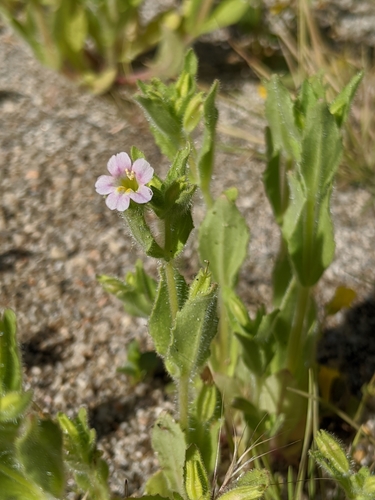
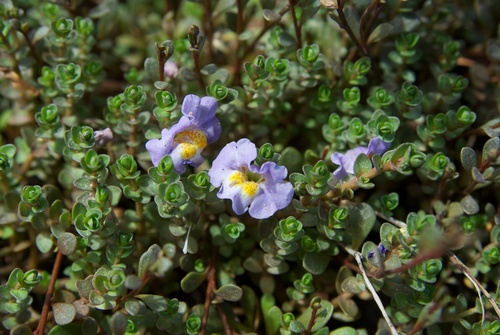
Thyridia repens is a low-growing perennial herb with low creeping branches that can reach up to 15 centimetres (5.9 in) tall, especially when the plant is sometimes submerged; it can form carpet-like colonies. Its small succulent leaves are unstalked, arranged oppositely, greenish-purple, and covered in tiny pits or dots. The flowers of this species are comparatively large, around 15 mm (0.59 in) across, and can be white, pale purple, lilac, or mauve. In natural field conditions, each flower opens for only a single day, and has noticeable yellow patches surrounded by white. Its cylindrical seed capsule grows to approximately 6.5 mm (0.26 in) long. In a study of T. repens conducted at Lake Ellesmere, the most common pollinators recorded were honey bees and the dronefly Eristalis tenax; these were followed by native bees Lasioglossum sordidum and Leioproctus, and the syrphid fly Melanostoma fasciatum. This species occurs in the North and South Islands of New Zealand, Tasmania, and mainland Australia. It is a coastal plant that typically grows on muddy or silty flats that are periodically inundated by high tides. In New Zealand, T. repens is widely but sparsely distributed and classified as naturally uncommon, particularly in the Auckland area. Notably, Thomas Kirk collected the type specimens of its synonym, Mimulus colensoi, from marshes in Onehunga. T. repens is resistant to submersion in salt water, but cannot tolerate taller-growing plants or more vigorous prostrate species. In some parts of New Zealand, it is threatened by the spread of the salt grasses Spartina and Carex divisa.