About Thyreus waroonensis (Cockerell, 1913)
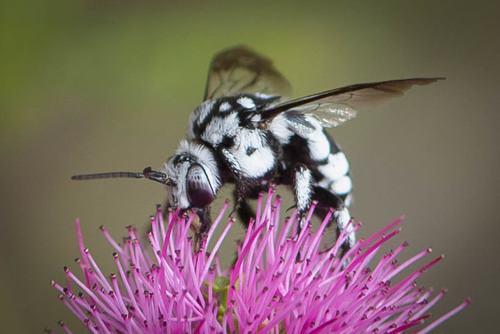
Thyreus waroonensis (Cockerell, 1913) has a body length of 8–12 mm, with forewings that measure 7.5–10 mm long. Its dorsal surface is black and marked with white hair spots. The portion of the forewings closest to the body is translucent, while the distal half is a smoky black colour. Most of the hindwings are translucent, but they gradually darken toward their tips. Its overall appearance is very similar to Thyreus caeruleopunctatus, but T. waroonensis can be distinguished by its longer, more slender antennae. This species is found across much of mainland Australia, and has also been recorded on Rottnest Island. Thyreus waroonensis, commonly called the Waroona cuckoo bee, is a kleptoparasitic species that uses bees of the genus Amegilla as its hosts. When the host bee is away from its nest, the Waroona cuckoo bee enters the nest and bites a small hole into the cap of a freshly sealed host cell. She then lays an egg near the host egg inside the cell, and repairs the hole in the cell cap. After hatching, the T. waroonensis larva uses its enlarged mandibles to kill the host egg, then consumes the stored food provisions inside the cell. The suspected Amegilla host species are A. chlorocyanea and A. calva. T. waroonensis has been observed collecting nectar from flowers of multiple plant species, including Eucalyptus and Melaleuca.