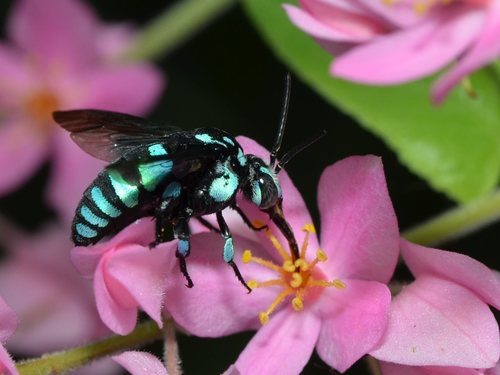
About Thyreus nitidulus (Fabricius, 1804)
Thyreus nitidulus, commonly called the neon cuckoo bee, is a parasitic bee belonging to the cuckoo bee genus Thyreus. It is a stocky bee best known for its striking bright bands of metallic blue and black. The species was originally described in 1804 by Danish entomologist Johan Christian Fabricius, under the name Melecta nitidula, from specimens collected in either the Aru Islands or northern Australia. In 1959, M. A. Lieftinck reclassified it to its current accepted scientific name, Thyreus nitidulus. The specific epithet nitidulus comes from the diminutive form of the Latin adjective nitidus, meaning "shining", so the name translates to "little shiny one". Several subspecies of Thyreus nitidulus are recognized. The nominate subspecies, T. n. nitidulus, is distributed across eastern and northern Australia, including New South Wales, Queensland, South Australia, and the Northern Territory, and is also found in New Guinea. Related species in the genus are found in Southeast Asia. Like all bees, the neon cuckoo bee is covered in furry, branched, flattened hair, which produces both its black and blue coloration. Pale blue hair covers most of the face of its head, along with patches on the sides of the thorax and on its legs. Its abdomen is striped with bright blue and black, and its transparent wings are a brown color with a purple tinge. The species has a sturdy build, with a reinforced thorax. Female neon cuckoo bees search for underground burrow nests of the blue-banded bee, Amegilla cingulata. When a partly completed brood cell is left unguarded, the female lays an egg inside it. After hatching, the cuckoo bee larva consumes the stored food larder intended for the host larva, and later emerges as an adult from the cell.