About Thyreus caeruleopunctatus (Blanchard, 1840)
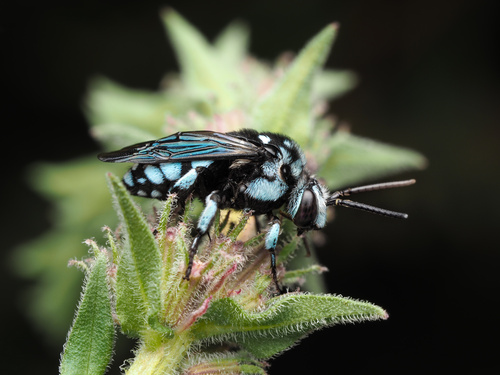
Thyreus caeruleopunctatus, commonly called the chequered cuckoo bee, is a stocky bee that reaches 10 to 12 millimetres in total length. Its body is mostly black, with four lengthwise rows of pale blue hair spots on the top of the abdomen, and two additional rows of the same spots on the underside of the abdomen. Like other species in the Thyreus genus, this bee has a flat projection from the thorax that covers its waist; this structure is thought to function as a shield. The thoracic shield bears a small blue hair spot, and pale blue hair also grows on the sides of the thorax. Its legs are spiny, with pale blue hair covering their outer surfaces. The head is large, with black-brown eyes, black antennae, a long tongue, and pale blue hair on the face. Forewings are 6.8 to 8.5 millimetres long and have a smoky grey-brown colour, while hindwings are mostly transparent. The chequered cuckoo bee is found across all mainland Australian states and territories, and has also been recorded in south-eastern New Guinea. It occupies a wide variety of habitats, including forests, woodlands, heaths, and urban areas. This species is diurnal and solitary. Female chequered cuckoo bees do not build their own nests, and lack the scopal hairs used to collect pollen. Instead, they follow host bees of the Amegilla genus to find their nests, then lay their own eggs in brood cells that have already been stocked with food by the host Amegilla. Thyreus caeruleopunctatus eggs hatch before the host Amegilla eggs, and the resulting larva consumes the stored food supply before pupating and emerging as an adult. The Amegilla larva is left with no food and starves to death. The specialised thoracic shield of this cuckoo bee is thought to be an adaptation that defends it against attacks from nesting female Amegilla. Amegilla pulchra has been confirmed as a host species for Thyreus caeruleopunctatus. Unlike the larvae and pupae of their Amegilla hosts, Thyreus larvae and pupae are far more active; this vigorous movement can be used to tell the two species apart when they share a nest. Adult chequered cuckoo bees have been recorded collecting nectar from a wide range of plant species, including members of the Asteraceae, Boraginaceae, and Myrtaceae families. Research carried out in Victoria, Australia has found that this bee is an important pollinator of the native orchid Spiranthes australis.