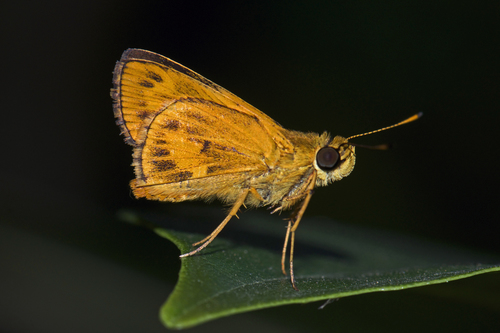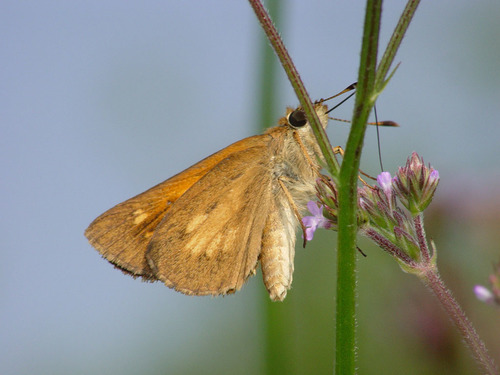
About Thymelicus sylvestris (Poda, 1761)
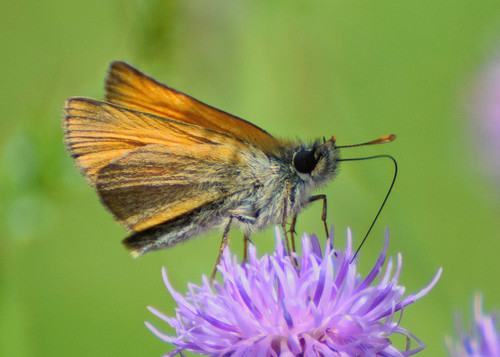
The small skipper, with the scientific name Thymelicus sylvestris, is a butterfly species belonging to the family Hesperiidae. Its natural range covers most of Europe (extending east to the Urals, and including Ireland, Britain, and Scandinavia), northern Africa, and the Middle East. It typically inhabits areas with tall growing grass. Eggs are laid loosely inside the grass sheaths of the caterpillars' food plants between July and August. After hatching, young caterpillars consume their own eggshell, then enter individual hibernation inside a protective cocoon made from a grass sheath, which is sealed with silk. Caterpillars resume feeding in the spring. Their most favoured food plant is Yorkshire fog, scientifically named Holcus lanatus. Other recorded food plants for the caterpillars include timothy (Phleum pratense), creeping soft grass (Holcus mollis), false brome (Brachypodium sylvaticum), meadow foxtail (Alopecurus pratensis), and cock's foot (Dactylis glomerata). In June, the caterpillars pupate near the base of their food plant. The first adult small skippers begin flying at the end of June, which is one to two weeks earlier than the first Essex skippers. Adult small skippers are strongly attracted to purple flowers like thistles and knapweeds.