About Thyene natalii G.W.Peckham & E.G.Peckham, 1903
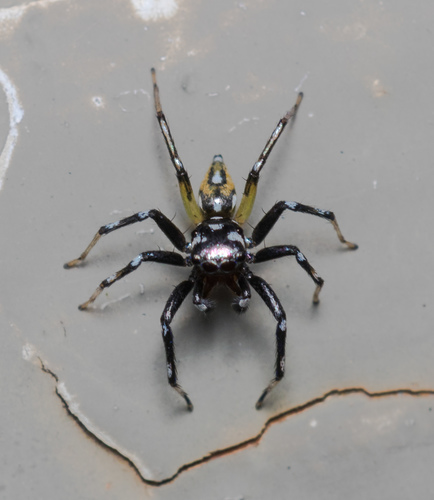
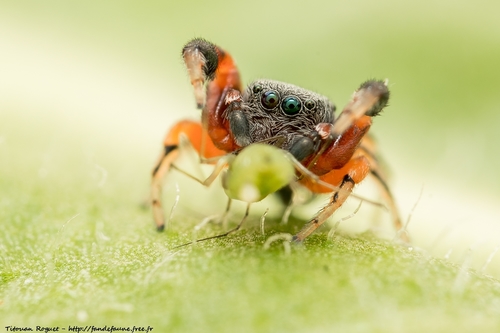
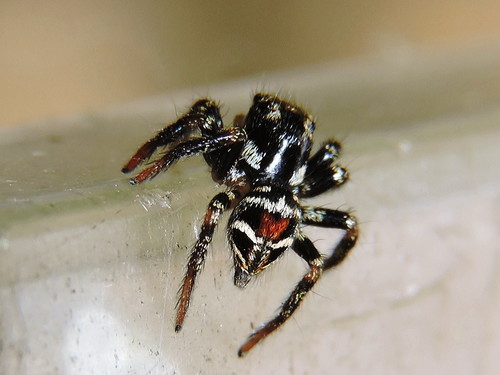
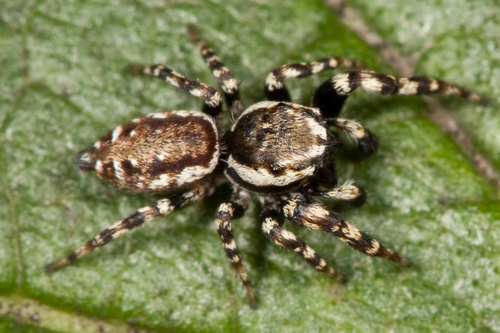
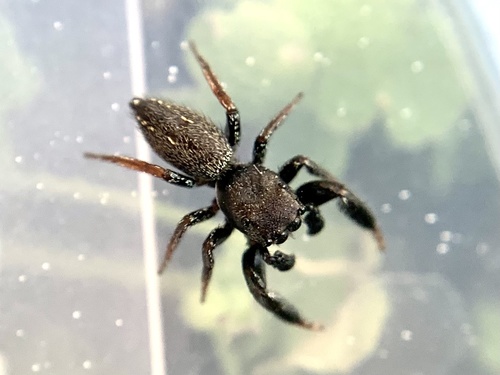
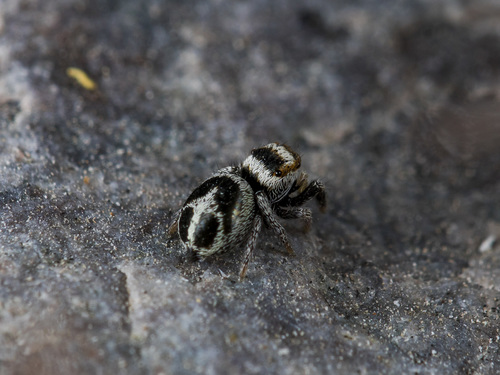
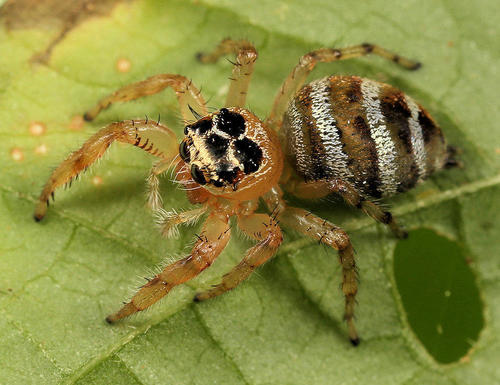
Thyene natalii was originally described by Peckham & Peckham, who differentiated it from other Thyene species found in South Africa. The species key for this group highlights the crosswise bands that mark the abdomen of both male and female T. natalii. Individuals of this species range between 5 and 8 mm (0.2 and 0.3 in) in length, and have an ovoid abdomen. The eye field occupies roughly half of the cephalothorax, which has approximately equidistant sides. The eyes are arranged in three rows: the anterior row holds the first four eyes, while the second and third rows each contain two eyes. The middle two eyes of the anterior row are almost twice as large as the lateral pair in this row. The second row sits closer to the first row, and the third row is somewhat narrower than the full width of the cephalothorax. T. natalii is the only species in its genus where both males and females have abdomens decorated with crosswise scales. In the original species description, the bands were recorded as identical for both sexes, made up of a series of lustrous silver scales and bright red hairs, though the original source specimens were worn. A later description, based on study of live specimens, identifies differences in abdominal decoration between males and females. Male abdominal bands are made of red and silver scales, while female abdominal bands consist of metallic to brown and white scales. In males, the cephalic part is dark brown, with a medium dark tan band running around the sides and back. The eye region is marked with metallic scales, and the face has three lines of reddish scales. A cluster of black hairs grows behind the lateral eyes. Males are distinguished by their sturdy front legs, which are also their longest legs. The female cephalothorax was first described as similar to that of the male, except that the cephalic part is light brown and females lack the cluster of black hairs. A later description again notes the light brown color of the female cephalic part, but adds that females do have a cluster of black hairs behind the anterior eyes. Females also have sturdy front legs, but are distinguished by having their third and fourth legs as the longest. Thyene natalii is distributed across Eastern and Southern Africa. In Eastern Africa, it has been observed in Ethiopia, Tanzania, Madagascar, and Kenya. In Southern Africa, it has been observed in Mozambique, Zimbabwe, Eswatini, and South Africa. In South Africa, T. natalii has been found in all of the country's more verdant floral biomes, as well as in several agricultural systems.