About Thyene imperialis (Rossi, 1846)
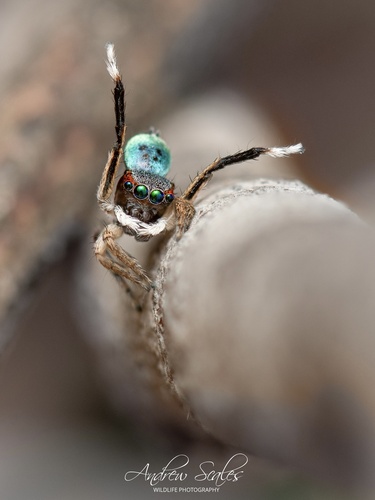
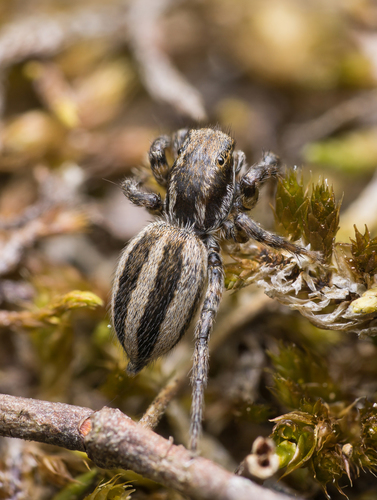
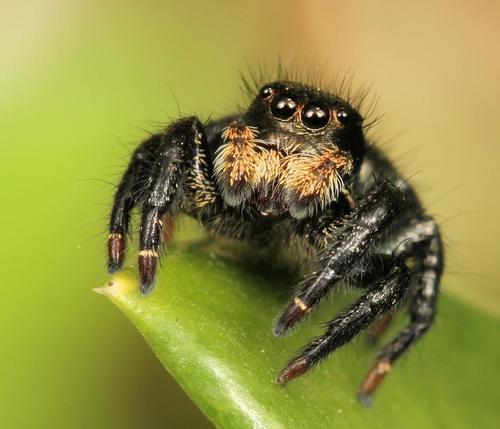
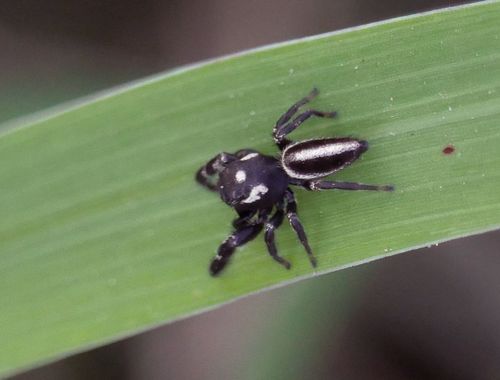
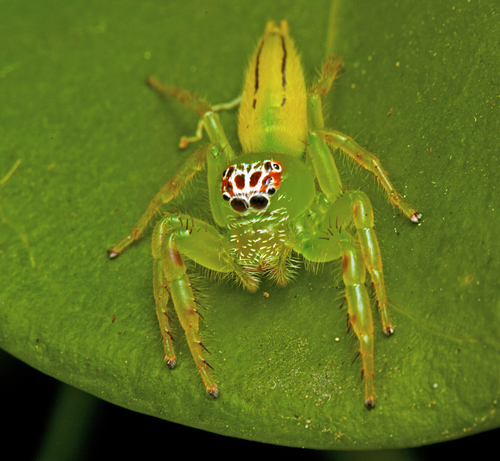
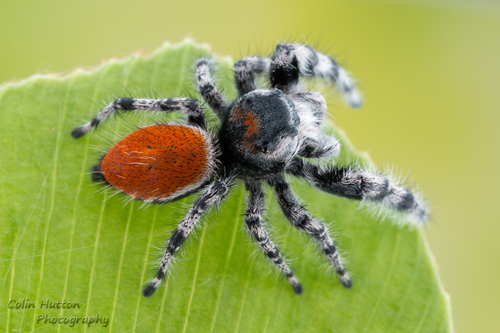
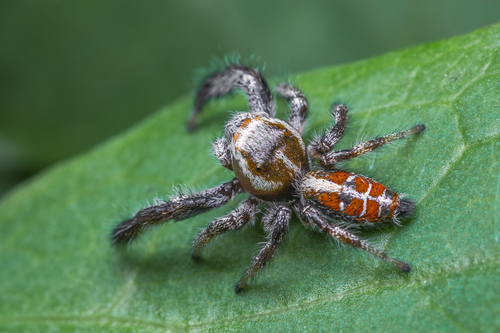
Thyene imperialis (Rossi, 1846) is a medium-sized spider. Its body is split into two main sections: a rounded rhomboid cephalothorax and a thinner, more oval abdomen. Male individuals have a yellow carapace (the hard upper surface of the cephalothorax) that is 2.65 to 3.25 mm (0.104 to 0.128 in) long and 2.2 to 2.9 mm (0.087 to 0.114 in) wide. The male carapace is relatively flat and wide, covered in white hairs and a small number of brown bristles, with a brown edge and a fawn-colored eye field. Black markings and long white hairs surround the spider's eyes. Carapace patterning varies between individuals, but may include a pale whitish-yellow semi-crescent toward the front and white scales on the rear edge. Characteristic "horns" made of black hairs sit on each side of the eye field. The front of the male spider is yellowish-fawn, with a blackish-brown lower clypeus (face) that has scattered visible white scales. The pedipalps are light brown and hold a few small, white, rounded scales. The mouthparts, including chelicerae, labium, and maxillae, are generally brown, with two small front teeth and one back tooth; the maxillae have whitish tips. The underside of the cephalothorax, called the sternum, is black with prominent dark hairs and bristles. The male abdomen is similar in length to the carapace but narrower, typically 2.7 to 3.3 mm (0.11 to 0.13 in) long and 1.7 to 2 mm (0.067 to 0.079 in) wide. It is brownish-russet with darker edges. The upper rear abdomen has a pattern of three narrow white patches on a dark brown or black background, with a few scattered brown and russet hairs; some individuals also have white hairs near the front. The underside of the male abdomen is dark with white edges. Males have dark brown spinnerets and brownish-black legs. The front legs are larger than the other legs, and all legs have very long, bushy black and brown hairs plus brown spines; some leg sections are orange. The male's copulatory organs include a brown cymbium with white tips. The round palpal bulb has an embolus with two tight coils, a small flap near its top, and a simple spike (tibial apophysis) on the palpal tibia. Females are similar to males, but have a light sandy carapace that is typically 2.9 to 3.25 mm long and 2.1 to 2.6 mm (0.083 to 0.102 in) wide. Their eye field is slightly darker, with darker hairs and bristles than the male's. The female sternum is light beige with a serrated black edge and scattered dark bristles. The female clypeus has prominent white scales, and the chelicerae, labium, and maxillae are light orange. Females have a larger abdomen than males, typically 3.2 to 4.9 mm (0.13 to 0.19 in) long and 2.2 to 3.2 mm wide. Some females have orange upper abdomens with beige longitudinal stripes, a pattern of four short white lines inside a black spot, and a white border around a central black band. The underside of the abdomen is light beige with longitudinal black stripes that do not extend all the way to the front or back. The legs are also beige with prominent dark hairs. Other female individuals have a pattern of dark square spots, a central spot bordered by two narrow front streaks, a thin dark central streak, and white spots at the rear. The rear of the abdomen has a yellow area, small white lines, and a darker triangular area, while the underside is whitish with grey lines. Additional females have other similar, variable intensity patterns. The female epigyne, the externally visible part of her copulatory organs, is yellow with slight sclerotization. It has a small, white, rectangular membranous groove; two slightly sclerotized copulatory channels extend from the groove's edge. These channels run toward the rear before forming a complicated flat spiral accessory gland. The multi-chambered spermathecae are heavily sclerotized. Thyene imperialis is widely distributed from Southern Europe, North and East Africa, across the Middle East to Central Asia, and further into China, India, Pakistan, with a range extending to Indonesia. In Africa, it has been recorded in Burkina Faso, Guinea, Ivory Coast, Mali, and Sudan. It is the only member of its genus recorded in Italy, and has also been observed in Iran and Turkmenistan. In 2025, it was reported as a non-native species in the United Kingdom. This spider is most often found in cultivated rather than uncultivated areas, and has been found among cereal crops and olive groves. It eats a wide variety of flies and other pests, and its use in biological pest control is currently being explored to protect a range of crops including cotton.