About Thunbergia laurifolia Lindl.
Scientific name: Thunbergia laurifolia Lindl.
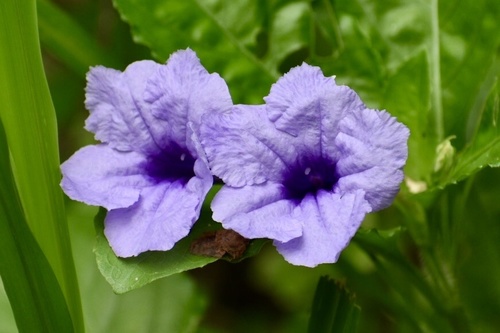
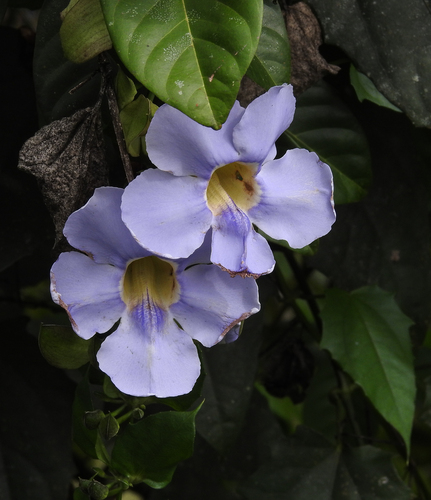
Thunbergia laurifolia has opposite, heart-shaped leaves with serrated margins that taper to a pointed tip. This species is very similar in appearance to T. grandiflora, but differs by having longer, thinner leaves, and hairless young stems and leaves. The flowers have no scent, and grow on pendulous inflorescences. These hermaphroditic flowers are trumpet-shaped, with a short broad tube that is white on the outside and yellowish on the inside. The corolla is pale blue, with 5–7 petals, one of which is larger than the others. Plants flower almost continuously year-round; individual flowers open in the early morning and wilt by the evening of the same day. Carpenter bees are frequent visitors, creeping into the flowers to collect pollen and nectar, while black ants are typically present as nectar scavengers. This plant develops a strongly tuberous root system.
In cultivation, Thunbergia laurifolia is a popular ornamental plant for tropical gardens. It is a fast-growing perennial herbaceous climber, and acts as a long-blooming vine when grown in cultivation. It can be propagated from stem cuttings or shoots growing from its tuberous roots. It has become an exotic weed in many tropical countries.
For traditional use as tea and medicine, in Malaysia, juice from crushed leaves of T. laurifolia is taken to treat menorrhagia, placed into the ear for deafness, and applied as a poultice for cuts and boils. In Thailand, the leaves are used as an antipyretic, and for detoxifying poisons. It is locally known as akar tuau in Malaysia and rang jeud (รางจืด) in Thailand. Several Thai herbal companies produce and export rang jeud tea. In Thailand, T. laurifolia is used for patients undergoing drug addiction treatment, and two studies on lab rats show T. laurifolia may stimulate dopamine production.