About Thunbergia grandiflora (Roxb. ex Rottler) Roxb.
Plant Height
Thunbergia grandiflora (Roxb. ex Rottler) Roxb. plants can reach around 20 meters in height.
Root System
They have an extensive long root system with a deep taproot that can grow as large as a small car.
Leaf Characteristics
Their opposite, stalked leaves have a rough surface and vary widely in shape: they may be triangular or ovate, and their margins can be toothed, lobed, or entire.
Leaf Size
Leaves grow up to 200 mm long and 60 mm wide, and are typically smaller than leaves of the very similar species Thunbergia laurifolia.
Flower Features
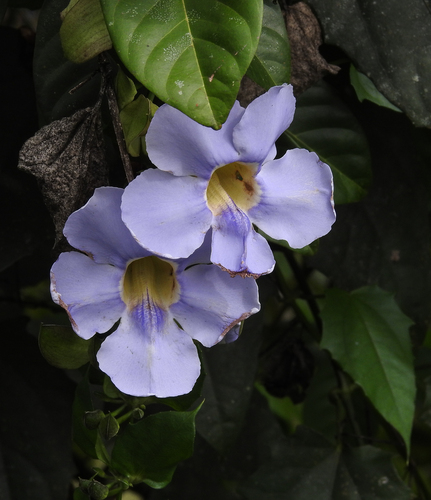
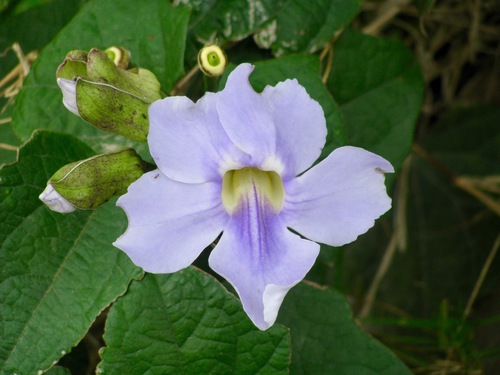
Its flowers range from blue to mauve, measure around 8 cm across, and have a 4 cm long tube that is pale yellow on the inside.
Seed Dispersal
After flowering, the plant produces seed-containing pods that eject their seeds several meters when ripe.
Vegetative Reproduction
Thunbergia grandiflora can also reproduce from plant segments that are washed down watercourses.
Cultivation Temperature Requirement
For cultivation, this species requires a minimum temperature of 10–13 °C (50–55 °F).
Cultivation Status
In temperate regions, it is grown as a houseplant, and has received the Royal Horticultural Society's Award of Garden Merit.
Weed Status in Australia
The species has become a serious environmental weed in Australia, growing on disturbed land along watercourses and in the wet tropics where it smothers other native vegetation.
Australian Distribution
It is commonly found growing north of Sydney, where it has been cultivated for many years.