About Thunbergia alata Bojer ex Sims
Thunbergia alata Bojer ex Sims grows as a vine. In warmer climates, it can reach a height of 5 meters (16 feet), while it stays much smaller when grown as a container plant or an annual. Its stems are twining, and it produces leaves that are heart-shaped or arrow-shaped. These leaves range from 3.5 to 7.5 centimeters long and 2.5 centimeters wide, and can be shaped from triangular to heart-shaped. The leaf edges are wavy, and both surfaces of the leaf are covered in fine hairs. Leaf blades are attached to petioles up to 6.5 centimeters long, which are spaced 4.5 to 13 centimeters apart along the main stem, which is 1 to 1.25 millimeters thick.
This plant is native to East Africa, and has become widely distributed across nearly the entire world in tropical and subtropical regions. Confirmed locations include China, eastern Australia, Hawaii, the US states of Texas and Florida in the Southern United States, Colombia, Puerto Rico, Mexico, South Africa, Portugal, Japan, New Zealand, the Cerrado vegetation of Brazil, Argentina, Madagascar, India, Thailand, and the Philippines, among other areas. It is grown as a garden plant worldwide, but has escaped cultivation and become naturalized in wild tropical and temperate forests. It is widely reported to be an invasive species, particularly in the Caribbean, Pacific islands, the region from Mexico to Colombia, and Japan. Its invasiveness is caused by several factors: it grows very quickly, wild pollination is easy even with its sporadic flowering times, its vine growth habit strangles other plants and blocks sunlight from them, it is hard to eradicate by hand because it leaves behind underground rhizomes that regrow rapidly, it has few natural predators in non-native regions, and people unaware of its harm to wild native plants often admire its appearance and choose not to remove it.
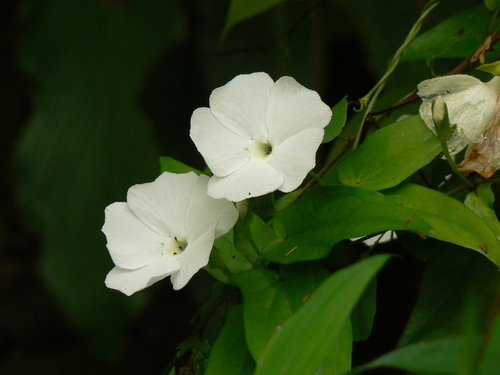
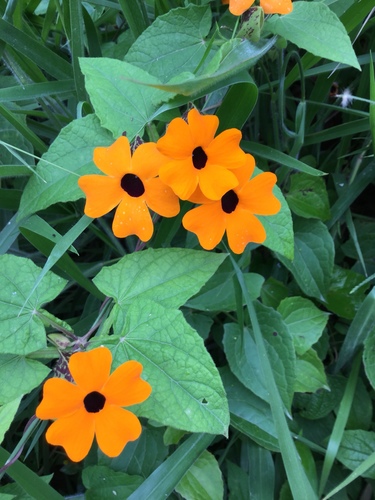
For cultivation, Thunbergia alata seeds germinate easily in humus-rich soil mixed with some sand, and the plant can also be grown from cuttings. Soaking seeds overnight in warm water improves germination rates after planting. It is a fast-growing plant that blooms quickly, and light trimming encourages the production of more blossoms. Cultivated varieties come with red, orange, red-orange, white, pale yellow, or bright yellow flowers, which may or may not have the characteristic chocolate-purple center that gives the species its common name.