About Thuja occidentalis L.
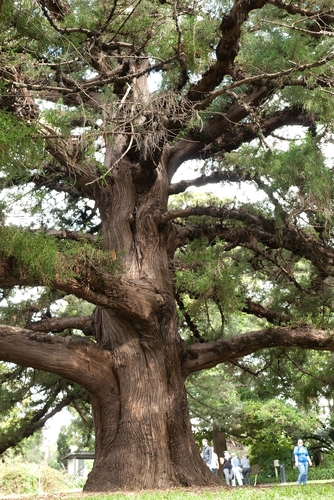
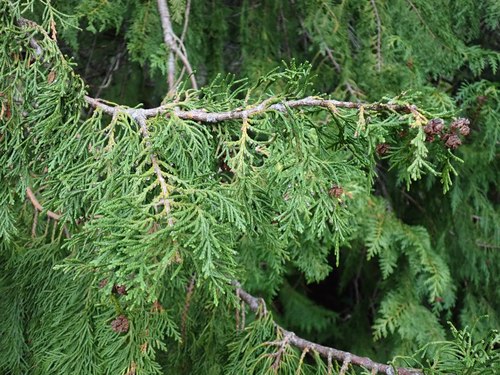
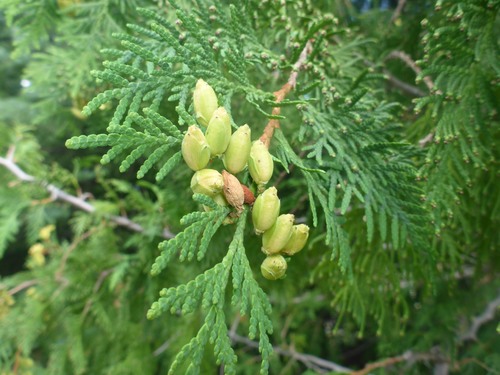
Scientific name: Thuja occidentalis L. Description Unlike its close relative western red cedar (Thuja plicata), northern white cedar (also called eastern white cedar or arborvitae) is only a small to medium-sized tree. It typically grows to 15 m (49 ft) in height with a 0.9 m (3.0 ft) trunk diameter, and can exceptionally reach 38 metres (125 ft) tall and 1.8 metres (5.9 ft) in diameter. The tree is often stunted or prostrate when growing in less favorable locations. Its bark is red-brown, furrowed, and peels in narrow, longitudinal strips. Northern white cedar has fan-like branches, scaly leaves, and foliage that forms flat sprays. The scale-like leaves are 3–5 millimetres (1⁄8–3⁄16 in) long. The seed cones are slender, yellow-green, and ripen to brown; they measure 9–14 millimetres (3⁄8–9⁄16 in) long and 4–5 millimetres (5⁄32–3⁄16 in) broad, with six to eight overlapping scales. Each cone contains around eight seeds. If the tree falls, its branches may take root. Distribution Northern white cedar is native to the southern part of eastern Canada and the adjacent northern United States. Its range extends from southeastern Manitoba east across the Great Lakes region into Ontario, Québec, New York, Vermont, New Hampshire, Maine, Prince Edward Island, New Brunswick, and Nova Scotia. Isolated populations occur in west-central Manitoba, further south in Massachusetts, Connecticut, Ohio, and Illinois, and in the Appalachian Mountains of Kentucky, Tennessee, North Carolina, Pennsylvania, Maryland, Virginia, and West Virginia. In Canada, its range reaches the Arctic treeline and the southern tip of Hudson Bay. It grows mainly in areas with cool summers, where July temperatures typically range from 16 to 22 °C (61 to 72 °F), and has a shorter growing season of 90 to 180 days. Ecology Northern white cedar grows naturally in wet forests, and is particularly abundant in coniferous swamps where other larger, faster-growing trees cannot compete successfully. It also grows on other sites with reduced tree competition, such as cliffs. While it is not currently listed as endangered, wild northern white cedar populations are threatened in many areas by high deer populations; deer favor the tree's soft evergreen foliage as winter food and strip it rapidly. The largest known specimen is 34 m (112 ft) tall and 175 cm (69 in) in diameter, growing on South Manitou Island in Leelanau County, Michigan. Northern white cedars can live very long lives under the right conditions, with especially old specimens growing on cliffs where they are inaccessible to deer and wildfire. As of 2008, the oldest known living specimen was 1,141 years old, while a dead specimen was found with 1,653 growth rings. Despite their great age, these very old trees remain small and stunted due to difficult growing conditions. Their long lifespans are attributed to their slow growth and ability to survive even when different sections of the tree are damaged or killed. The Witch Tree, a T. occidentalis growing from a cliff face on Lake Superior in Minnesota, was recorded as a mature tree by French explorer Sieur de la Verendrye in 1731, and it is still alive today. Specimens growing on cliff faces in southern Ontario are the oldest trees in Eastern North America and all of Canada, reaching ages over 1,653 years. Uses Thuja occidentalis is used commercially for rustic fencing and posts, lumber, poles, shingles, and log cabin construction. It is the preferred wood for structural elements such as ribs and planking for birchbark canoes, as well as planking for wooden canoes. The plant's essential oil has been used in cleansers, disinfectants, hair preparations, insecticides, liniment, room sprays, and soft soaps. The Ojibwa reportedly made soup from the inner bark of soft twigs; others have used twigs to make teas to relieve constipation and headache. As arborvitae, eastern white cedar is a popular ornamental plant for both residential and commercial landscapes. Thuja occidentalis holds important cultural significance in traditional Ojibwe culture. It is honored with the name Nookomis Giizhik (Grandmother Cedar), is the subject of sacred legends, and is considered a gift to humanity for its wide range of uses including crafts, construction, and medicine. It is one of the four plants of the Ojibwe medicine wheel, associated with the north. The foliage is rich in vitamin C, and is believed to be the annedda that cured scurvy among Jacques Cartier and his party during the winter of 1535–1536. Because it contains the neurotoxic compound thujone, internal use can be harmful if used for prolonged periods or during pregnancy. Cultivation T. occidentalis is widely planted as an ornamental tree, particularly for screens and hedges, in gardens, parks, and cemeteries. Over 300 cultivars exist, showing wide variation in color, shape, and size. Common cultivars include 'Degroot's Spire', 'Ellwangeriana', 'Hetz Wintergreen', 'Lutea', 'Rheingold', 'Smaragd' (also called 'Emerald Green'), 'Techny', and 'Wareana'. It was introduced into Europe as early as 1540. The following cultivars have received the Royal Horticultural Society's Award of Garden Merit: 'Danica', 'Golden Tuffet', 'Holmstrup', 'Rheingold', 'Smaragd'.