About Thraupis cyanoptera (Vieillot, 1817)
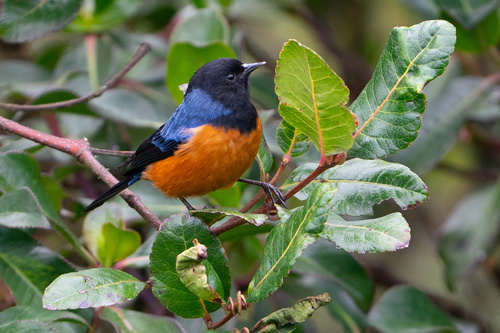
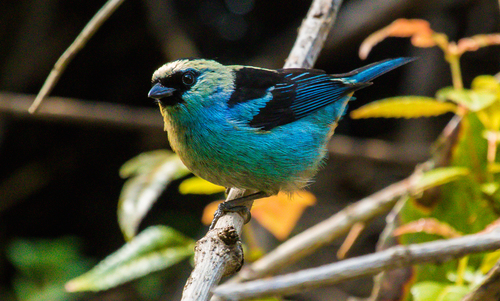
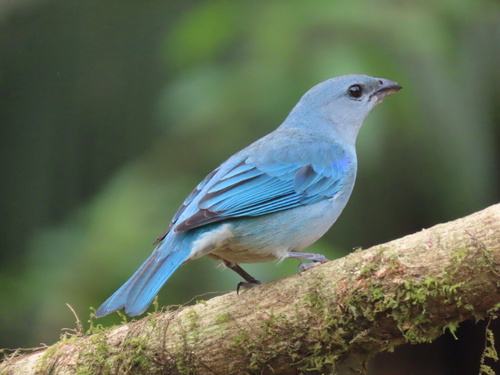
The azure-shouldered tanager (Thraupis cyanoptera) is a large, thick-billed tanager. It averages 18 cm (7.1 in) in length, and weighs between 41–46 g (1.4–1.6 oz). Males and females have identical appearance and similar body dimensions. Adult azure-shouldered tanagers are predominantly blue overall: their heads and upperparts are gray-blue, with darker feathering around the lores, and brighter blue on the crown. Their throat and underparts are paler than their upper body, while their rump, uppertail coverts, and tail are bright blue, and their flanks have a soft greenish tint. Their upperwing-coverts are a rich, glossy violet-blue; their greater coverts are dark with wide turquoise-blue edges. Their primary coverts and flight feathers are dusky, with broad turquoise fringes. The upper mandible of the bill is blackish, while the lower mandible is blue-gray. The iris is dark brown, and the legs are dark horn-gray. Juvenile azure-shouldered tanagers have duller coloration than adults. This species is endemic to the Atlantic Forest of southeastern Brazil, where its range extends from southeastern Bahia, eastern Minas Gerais, and Espírito Santo, south to northern Rio Grande do Sul. There are unconfirmed reports of this species as far west as Paraguay, but these records are currently believed to be misidentifications of sayaca tanagers. Compared to other tanagers in the Thraupis genus, the azure-shouldered tanager shows a stronger preference for forested habitats. It lives in humid montane forests, open woodlands, secondary growth, and forest edges; it has also been recorded in orchards on Santa Catarina Island. It occurs mostly on the Atlantic slopes of the Serra do Mar. The species can be found at elevations up to 1,600 m (5,200 ft), though it most often occurs below 1,200 m (3,900 ft). It is thought to be mostly non-migratory, though it may make seasonal movements in the southernmost part of its range.