About Thomisus onustus Walckenaer, 1805
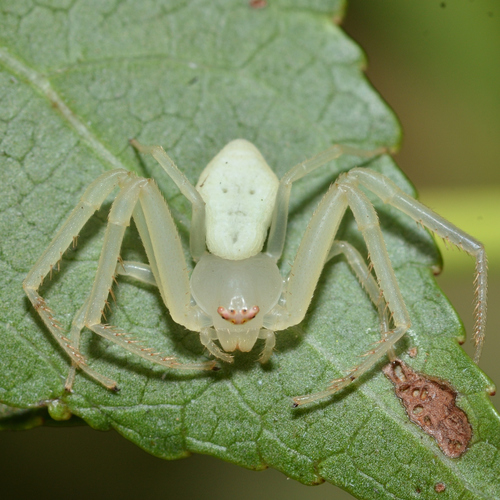
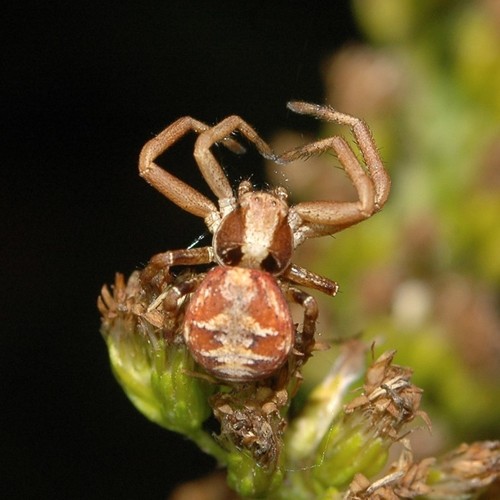
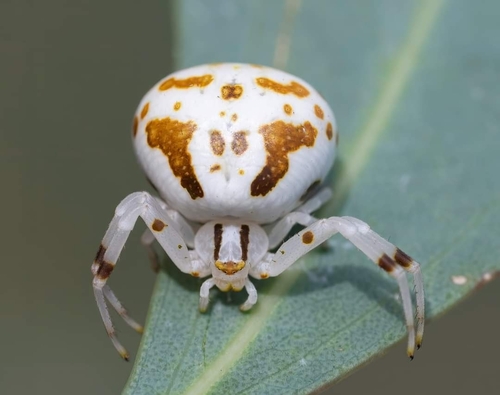
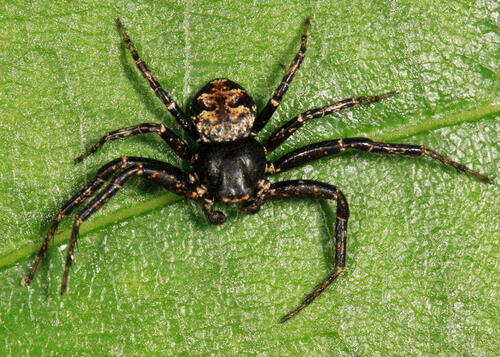
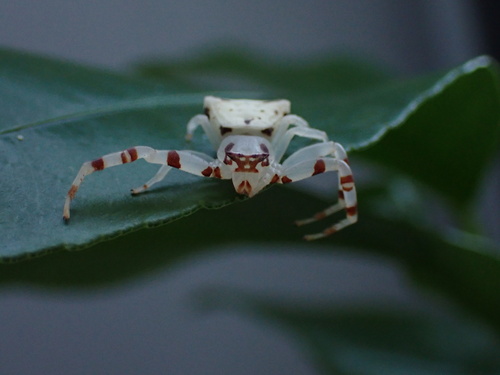
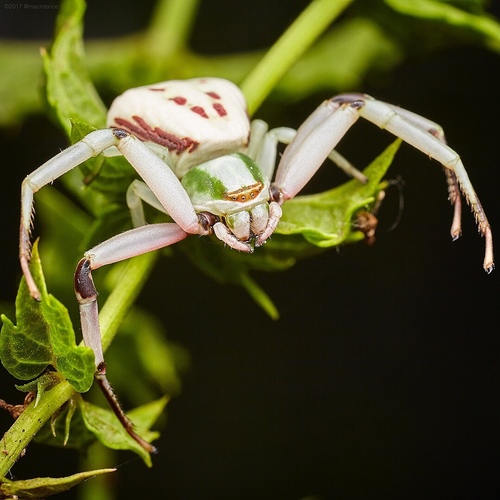
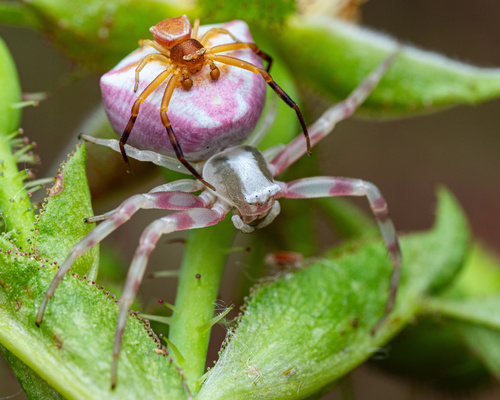
Thomisus onustus is a medium-sized spider that shows clear sexual dimorphism. Females measure 7–11 mm in body length, while males are smaller at just 2–4 mm. Females have heavy bodies and are mostly stationary, whereas males are slender and more active. Female prosomas are pink, yellow, or white, while male prosomas range in color from brown to green-yellow. Individuals of both sexes have a triangular opisthosoma. This species can be told apart from its close relative Thomisus zyuzini by several traits: its long ventral tibial apophysis and retrolateral tibial apophysis, the specific arrangement of the basal tibia tubercle on the male palp, and its circular intromittent orifice, which is oriented toward the front of the epigynum. T. onustus typically lives on shrubs and in lowland vegetation, and prefers warm areas. It occupies a wide range of flowers and herbs, and usually stays at sites that are at their flowering peak. What makes this species unique among crab spiders is that it prefers to position itself in flower centers (which have distinct spectral properties) rather than on flower petals. T. onustus is distributed across Europe, North Africa, Turkey, the Caucasus, Russia (from European Russia to South Siberia), Israel, Central Asia, Iran, China, Korea, and Japan, and favors warm habitats across this range. During the summer of their second year, near the end of their lives, female T. onustus weave between two and four cocoons to lay their eggs. Spiderlings from the earliest laid egg sac emerge in late summer. This emergence timing lets them access more abundant prey, which allows them to build up enough energy reserves to hibernate outside their cocoon in vegetation over winter. In contrast, spiderlings from later-laid egg sacs stay inside their egg sacs through winter, and emerge in early spring of the next year when prey is much scarcer. These spring-emerging spiderlings must supplement their diet by feeding on pollen to meet their nutritional and energy needs. T. onustus has two generations per year, and the spring generation is larger than the summer generation. Females of both generations generally develop throughout the year. Males of the spring generation grow faster, and reach maturity alongside second-generation females from the previous year. Males of the summer generation develop over a longer period, molt several times, and reach maturity in the summer of the next year alongside first-generation females. Developmental rates for both sexes are highly variable, and spiders at different developmental stages can be found throughout the year. Overall, the species has high variability in developmental rate, instar duration, number of molts, and timing of molting across individuals. T. onustus usually attaches its egg sacs to leaves. Unlike some other cursorial spider species, females do not enclose themselves inside the egg sac, and continue catching prey while guarding their eggs.