About Thomisus labefactus Karsch, 1881
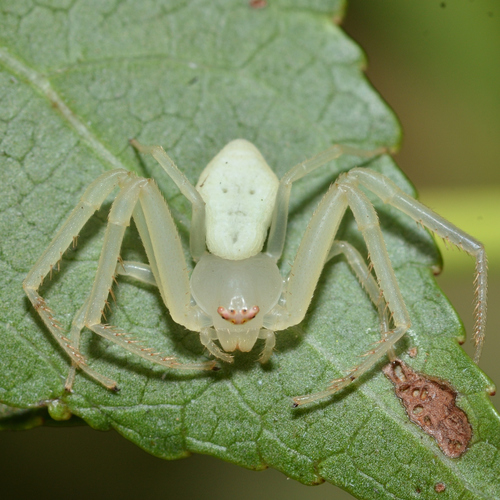
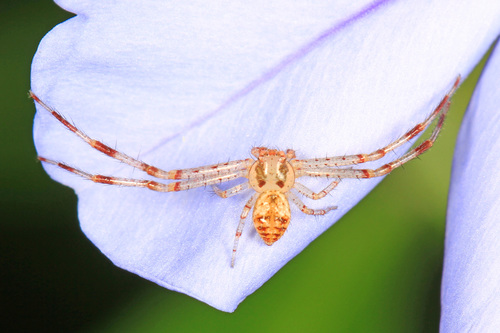
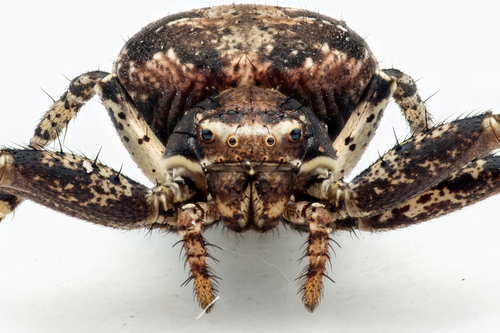
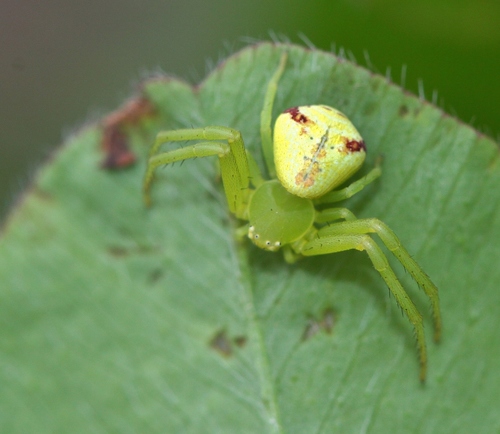
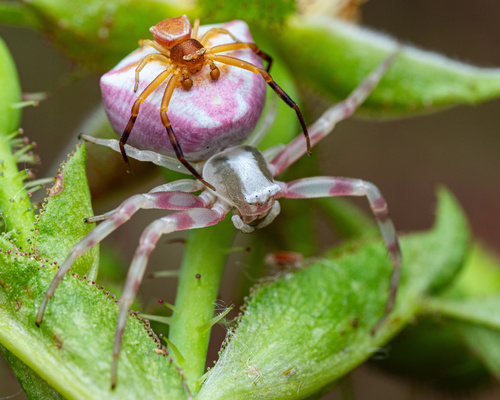
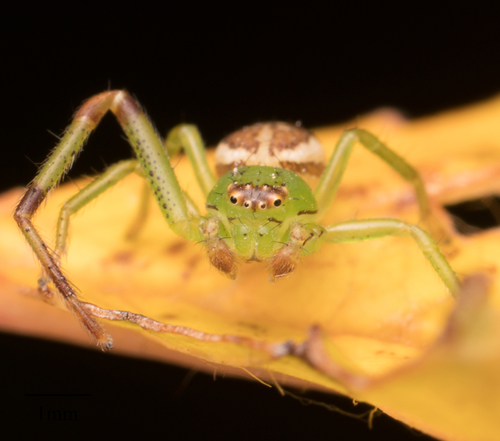
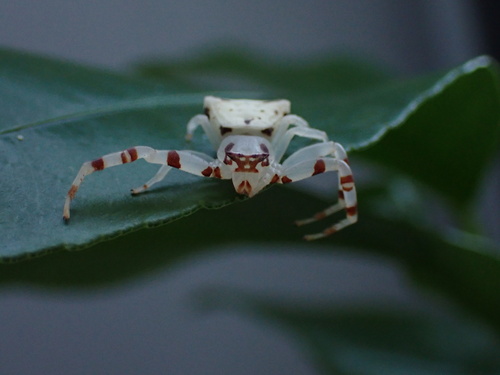
Like other crab spiders, Thomisus labefactus exhibits sexual dimorphism. Females can reach a total length of up to 9 mm, while males are considerably smaller at approximately 6.3 mm. This species shows considerable color variation: some individuals are yellowish-white with brown markings, and others may be more uniformly colored. Females typically have a yellowish-white abdomen with distinctive brown muscle impressions arranged in the center of the upper half, along with two rows of smaller similar markings along the outer edges. Mature specimens often have two deep black spots on the corners of the abdomen, connected by a bluish streak. The legs are yellow with white markings, and the anterior legs (I and II) bear spines on the metatarsi and tibiae. Males are much darker in coloration and have less distinct markings than females. Their cephalothorax is reddish-brown with darker edges, and their abdomen does not have the prominent black corner spots seen in females. Thomisus labefactus has been recorded from Korea, Japan, China, Taiwan, and Thailand, and appears to be widely distributed across East and Southeast Asia. Ecologically, this species is somewhat nomadic, but females construct a protective nest when guarding eggs. Females build this nest by pulling the edges of a leaf together with irregularly spaced silk threads, forming an enclosure around a shallow cocoon that holds the eggs. Females show notable dedication to egg protection: they do not abandon their eggs regardless of disturbance. Young spiders, measuring approximately 2 mm in length, have been observed overwintering under bark.