About Thlaspi arvense L.
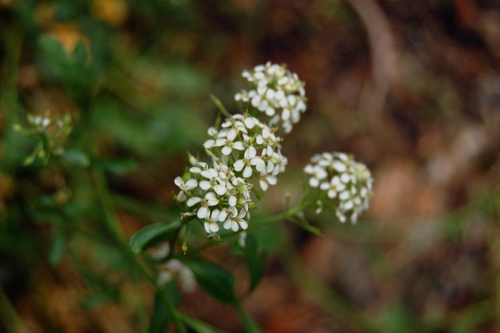
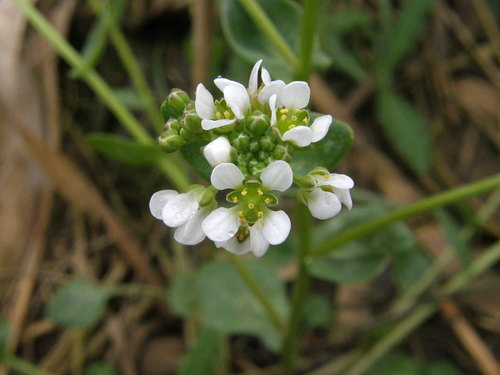
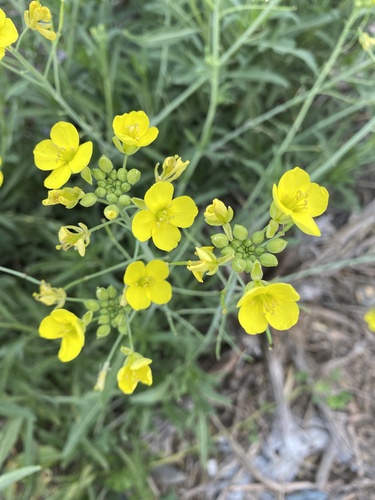
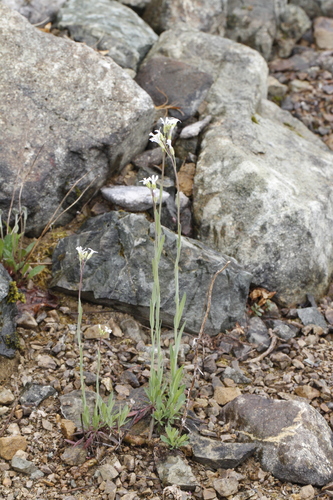
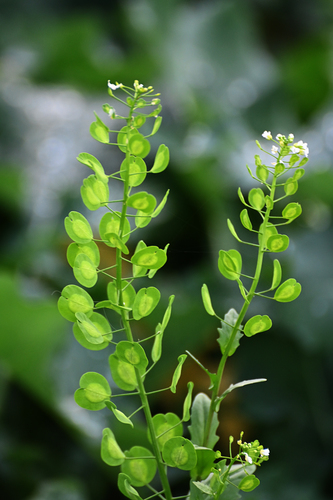
Thlaspi arvense L., commonly known as pennycress, is an annual plant with an unpleasant odor when squeezed. It is foetid and hairless, growing between 40 and 80 cm tall, reaching up to 60 cm on average, with upright branches. Stem leaves are arrow-shaped, narrow, and toothed. It blooms between May and July, producing racemes or spikes of small flowers that typically have 4 sepals and 4 longer petals; flower colors are usually white, but may also be lavender or pink. After blooming, it forms round, flat, winged pods around 1 cm across with a deep apical notch, though some describe seed pods as heart-shaped and penny-sized. Each pod can hold up to 14 small, oval, dark brown to brown-black seeds that are slightly larger than camelina (Camelina sativa) seeds. Its common name "pennycress" comes from the shape of its seeds, which resemble an old English penny. Other English common names include stinkweed, bastard cress, fanweed, field pennycress, frenchweed, and mithridate mustard. It is an overwintering annual herb that is typically planted and germinates in the fall, overwintering as a small rosette. Flowers are self-pollinated. The ploidy of this species is 2x. Its seeds have a high oil content, so the species has gained interest as a potential feedstock for biofuel and renewable biodiesel production, and is currently being developed as an oilseed crop for this purpose. As a winter annual, it grows across much of the Midwestern United States and many other regions of the world. This species is native to temperate regions of Eurasia, where it is considered an archaeophyte, an ancient introduction, across much of its native range. It has naturalized to North America, giving it an overall circumpolar distribution. It is found throughout Europe, although it is absent from Iceland, the Faroe Islands, Svalbard, Portugal, and Mediterranean islands, and is relatively rarer in the Arctic and mainland Mediterranean regions. Its native range extends through the Greater Caucasus, the Armenian Highlands, northwestern Iran, Kazakhstan, southern Siberia to the Pacific coast of Khabarovsk and Primorsky Krai, the Altai, Tian Shan and Pamir mountains, Korea, the Japanese Archipelago, all but the southeasternmost provinces of China, and the northern mountains of South Asia: it occurs in Nepal at 2000–4600 m, in the Indian regions of Jammu and Kashmir and Ladakh, and in Pakistan's Chitral, Hazara, Kurram Valley, as far south as Rawalpindi District. It is also found in Ethiopia, and has been introduced to Australia and the Americas. In the northern United States, it grows in cropland, fallow fields, areas along roadsides and railroads, garden plots, weedy meadows, and waste areas. It prefers disturbed habitats, and has a low capacity to invade higher-quality natural habitats, and is classed as a weed of cultivated land and wasteland. A study conducted in Germany found that a pennycress-corn double-cropping system increased spider diversity more than mustard-corn, green fallow-corn, or bare fallow-corn double cropping systems. Adding pennycress to a corn rotation also increased and stabilized ground beetle diversity more effectively than the other tested rotations, an effect attributed to the evenness of plant cover throughout the growing season, meaning bioenergy production from double-cropped pennycress may support ground beetle diversity. Pennycress can be part of a comprehensive integrated weed management strategy. When established in the fall, it provides early spring ground cover and suppresses aggressive spring-germinating weeds such as common lambsquarters (Chenopodium album), giant ragweed (Ambrosia trifida), and tall waterhemp (Amaranthus tuberculatus). In 2015, Johnson et al. speculated that when accounting for pennycress seeding rates and companion crops, this weed suppression may be caused by allelopathic compounds rather than just ground cover. For human consumption, field pennycress has a bitter taste, so it is usually parboiled to remove bitterness. It is most often used in salads, and sometimes in sandwich spreads, and is noted to have a distinctive flavour. When grown for biofuel, pennycress is planted in fall, germinates and forms an overwintering vegetative mass, and its oil-rich seed is harvested in spring for use as a biodiesel feedstock.