About Thermopsis rhombifolia (Pursh) Richardson
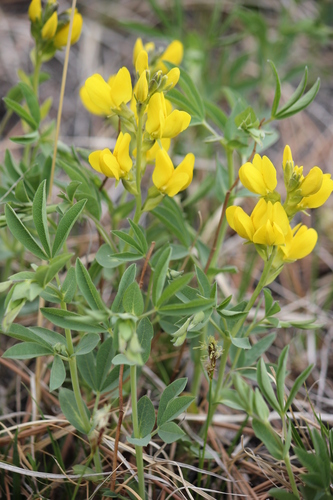
Thermopsis rhombifolia, commonly called prairie thermopsis, is a flowering plant belonging to the legume family. It is native to North America, where it occurs across the Great Plains and extends into the lower canyons of the Rocky Mountains. Its natural habitat consists of dry grasslands and woodlands. This species is a perennial herb that produces yellow flowers during the spring. Thermopsis rhombifolia contains multiple quinolizidine alkaloids, including anagyrine, thermopsine, rhombifoline, cytisine, N-methylcytisine, 5,6-dehydrolupanine, and lupanine. Alkaloid content is highest in the plant's seeds. Documented cases of accidental ingestion by children show a range of symptomatic responses: After eating a handful of the plant's immature seeds, called "peas", a 6-year-old girl developed a headache around 6–7 hours after ingestion that persisted for 12 hours, alongside mild vomiting. Another 6-year-old child, a boy, ate an unknown number of these peas; he began vomiting around 4 hours after ingestion, had mild vomiting that continued for 2 hours, and experienced nausea but no headache. In a separate case, an 8-year-old boy ate approximately 6 peas, started vomiting 3–4 hours after ingestion, and reported abdominal cramping and headache. Most vomiting happened in the first few hours, and symptoms gradually faded over the following 24 hours. A 6-year-old boy ate 20 or more of the plant's flowers; he developed abdominal pain and cramps around 45 minutes after ingestion, and vomited 6–7 times over the next 8 hours. Within an hour of ingestion, he became drowsy and weak, and had multiple episodes of dizziness and stumbling that continued through the first few hours. After 4 hours, he developed a headache that lasted 10–12 hours. His blood pressure and heart rate were not significantly affected, and he was treated with activated charcoal. In another separate case, a 6-year-old girl ate 2–3 flowers, and developed nausea and lethargy within an hour. Her symptoms subsided over the next 3–4 hours.