About Theridion grallator Simon, 1900
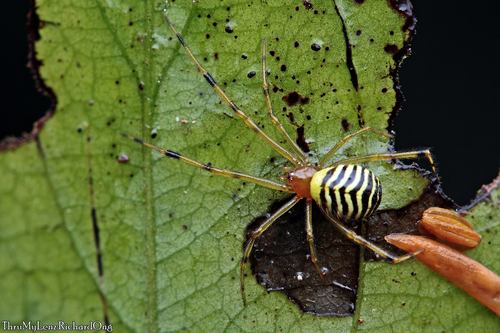
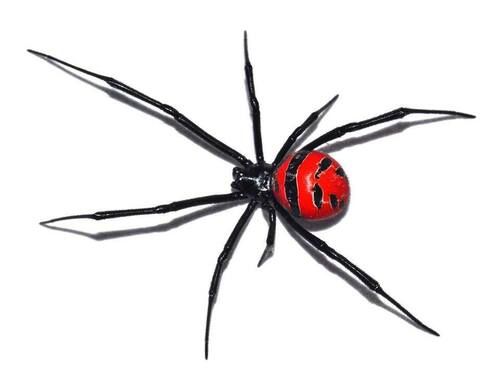
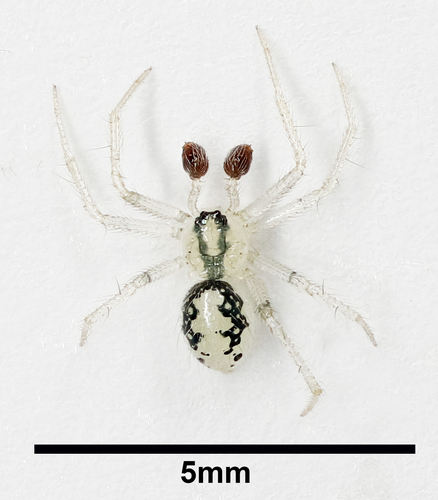
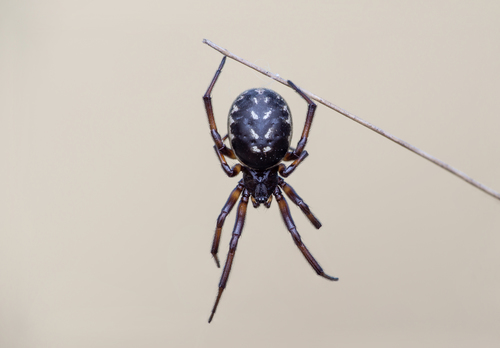
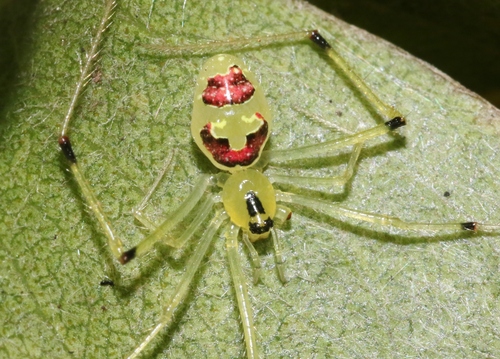
Theridion grallator is a small spider with a total body length shorter than 5 millimeters. It has characteristically long, slender legs and a translucent yellow body. Its distinctly long legs make its body morphology the most divergent among all members of its clade, a unique trait that arose from an ecological or behavioral shift. The abdomen is often pale, translucent yellow, and may also have a variety of superimposed red, white, and/or black patterns. Certain morphs have a pattern resembling a smiley face or a grinning clown face on their yellow body, which is the origin of this species' common name. These patterns differ between islands, and some individuals have no abdominal markings at all. Abdominal color changes from translucent yellow to green or orange based on the spider's diet. The extensive color polymorphism of T. grallator provides an evolutionary benefit by helping it evade predation: birds that hunt using search images (focusing on the most common local color morph to identify prey) are less likely to detect spiders with depigmentation or varied colors and patterns. T. grallator lives in wet and mesic environments: wet environments have an annual rainfall of 200 to 350 centimeters, while mesic environments have an annual rainfall of 100 to 200 centimeters. These spiders are found in the forests of the Hawaiian Islands, specifically on O’ahu, Moloka’i, Maui, and Hawai’i. They prefer to live on the underside of plant leaves, including the native species Broussaisia arguta and Clermontia arborescens, and the introduced species Hedychium coronarium. H. coronarium is a particularly favorable host plant: its large, slippery leaves help T. grallator evade predators more effectively. These spiders can be found in kipukas, areas of land surrounded by lava flows, but do not live in the surrounding lava flows themselves. T. grallator is endemic to the Hawaiian archipelago. Sparse populations have been recorded on Oʻahu, Molokaʻi, Maui, and the island of Hawaiʻi, in rainforests at elevations between 300 and 2,000 meters (980 to 6,560 feet). The proportion of different color morphs varies somewhat between the islands of Maui and Hawaiʻi. On Maui, the most common patterned morph is the Red front, which has a red U shape on the anterior dorsum. The opisthosoma color morphs Yellow, Red front, Red blob, and Red ring are found in both male and female T. grallator on Maui. On the island of Hawaiʻi, these morphs are sex-specific: Yellow and Red blob only occur in females, while Red front and Red ring only occur in males. Yellow and Red front are controlled by the same alleles in females, just as Red blob and Red ring are controlled by the same alleles in males. When a female T. grallator is undergoing her final molt, a mature male may share the same leaf with her. After the female finishes her molt, the male copulates with her. A few weeks after copulation, the female deposits her egg sacs, and stays closely attached to the egg sacs via a short silk thread until the eggs hatch. When the egg sacs are ready to hatch, the mother loosens the silk wrapping around the eggs to let the spiderlings emerge. T. grallator populations see seasonal fluctuations in spider size and sex ratio. During winter months, from October to March, a higher proportion of the population is made up of smaller, immature spiders. In spring, from May to August, there are more adults in the population, and the majority of these adults are maternal females. In late spring and early summer, up to 85% of a population can be maternal females carrying egg sacs. Morph frequency differs between mature and immature T. grallator. Mature spiders do not have the black or maroon patterns that appear on spiderlings. Additionally, the Red blob morph, defined by red pigment covering the entire abdomen, has a much higher frequency in adult T. grallator. This pattern indicates that maroon and black patterns on spiderlings develop into the Red blob pattern when spiders reach maturity.