About Thelymitra villosa Lindl.
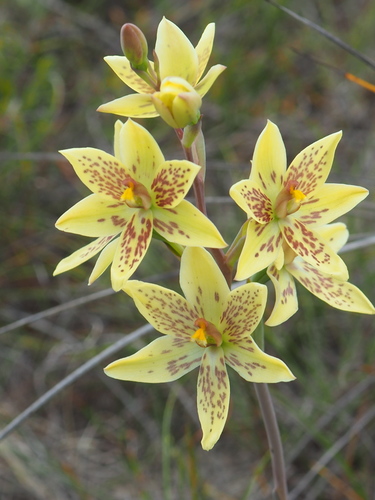
Thelymitra villosa, commonly known as the custard orchid, is a terrestrial, perennial, deciduous herb that grows from an underground tuber. It produces a single erect leaf at the base of its flowering stem. The leaf measures 60–100 mm (2–4 in) long and 20–50 mm (0.8–2 in) wide, and is covered in white, silky hairs. Between one and twenty flowers, each 30–40 mm (1–2 in) in diameter, are borne on a flowering stem that grows 300–600 mm (10–20 in) high. The flowers are yellow with variable amounts of red-brown spots and blotches. It has a distinctive column that is yellow, reddish, or brown, with a glandular mid-lobe and hairy lateral lobes that are joined to one another. Flowering takes place from September to November. The flowers of T. villosa are similar to those of the leopard orchid Thelymitra benthamiana and the sun orchid Thelymitra sargentii, but T. villosa can be distinguished from these species by its shorter, broader leaf that is covered in hairs. This orchid is endemic to the south-western corner of Western Australia, where it occurs in the Avon Wheatbelt, Esperance, Geraldton Sandplains, Jarrah Forest, and Swan Coastal Plain biogeographic regions. It grows in sandy clay, and grey, white, or yellow sand that stays wet through winter.