About Thelymitra rubra Fitzg.
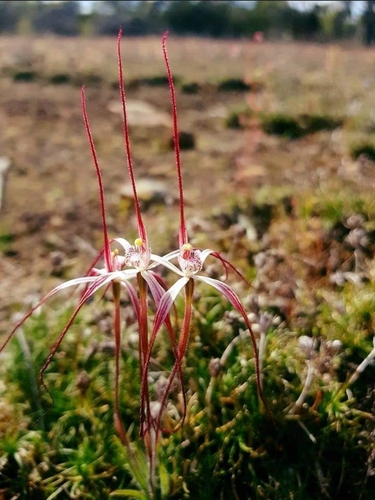
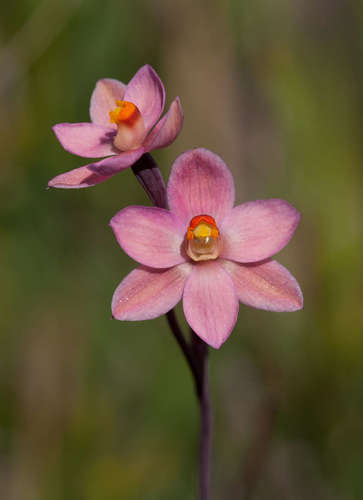
Thelymitra rubra, commonly called the salmon sun orchid, is a tuberous perennial herb. It produces a single thin, channelled leaf that is green or purplish, and ranges from thread-like to linear in shape. The leaf measures 80 to 200 mm (3 to 8 inches) long and 3 to 5 mm (0.1 to 0.2 inches) wide. Up to five flowers, each 20 to 25 mm (0.8 to 1 inch) wide, are borne on a thin, wiry flowering stem that grows 200 to 400 mm (8 to 20 inches) tall. Most flowers are salmon pink, though they sometimes occur in other shades of pink, and more rarely are cream-coloured or very pale pink. The sepals and petals are 8–12 mm (0.3–0.5 in) long and 4–5 mm (0.16–0.20 in) wide. The plant's column, a reproductive structure, is cream to pinkish, has a black, red, or orange band near its top, and measures 4–5 mm (0.16–0.20 in) long and about 2.5 mm (0.1 in) wide. The lobe on top of the anther is short, brownish, and has a toothed tip. The side arms on the column are broad, yellow, and have finger-like edges. Flowers of this species open on sunny days, and are sometimes self-pollinating. Flowering takes place from September to November. This sun orchid species is similar to Thelymitra carnea, but can be told apart by its larger flowers, salmon pink rather than bright pink colour, and fringed column arms. The salmon sun orchid grows in forest, heath, and coastal scrub. It is found in southern New South Wales, south-eastern South Australia, Tasmania, and is most widespread and common in all parts of Victoria except the north-west. Specimens from Tasmania usually have a few hair-like strands on the sides of the column.