About Thelymitra antennifera (Lindl.) Hook.f.
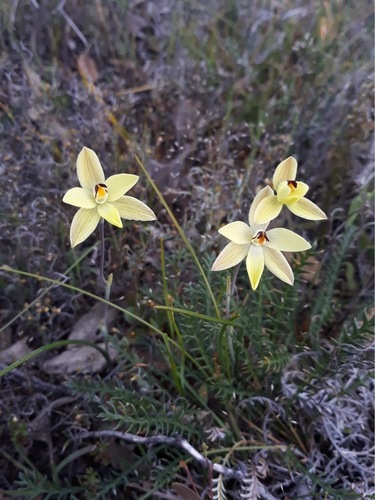
Thelymitra antennifera (Lindl.) Hook.f. is a tuberous, perennial herb that grows 10–25 cm tall and produces yellow flowers between July and October. It has a single leaf that is circular in cross-section, measuring 5 to 12 cm long and 2 to 3 mm wide. The inflorescence holds one to four yellow flowers on a wiry, zig-zagged, often pinkish stem. Each open flower is 20 to 40 mm across and carries a lemon or vanilla scent. Its sepals and petals are 12 to 20 mm long and 4 to 6 mm wide, with a broad, reddish-brown band on the outer surface of the sepals. The reproductive column is 5 to 6 mm long and 2 to 3 mm wide, with dark brown, ear-like arms that are held high above the column. Like other species in the genus Thelymitra, this species reproduces from seeds. It is unusual among the genus as one of the few species that develops tubers at the end of stolon-like roots, which lets it form new colonies. Its flowers are insect pollinated, open easily even on cool days, and are long-lasting. This species occurs in the South-West and Eremaean botanical provinces of Western Australia, and is also found in South Australia and Victoria. In Tasmania, it only grows in a small number of small areas and is classified as an endangered species there. In all other parts of its range it is widespread and common, growing in a wide range of habitats, most often shrubland, heath and mallee. It sometimes forms dense, extensive colonies and flowers freely, particularly after fire. Species of the genus Thelymitra can be readily cultivated in pots.