About Thelocactus hexaedrophorus (Lem.) Britton & Rose
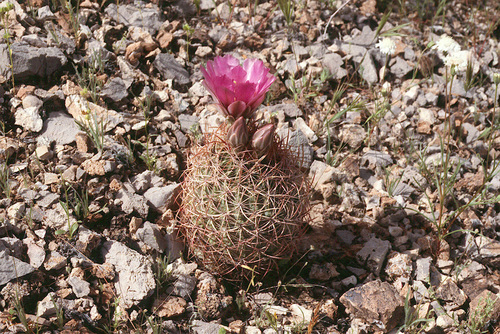
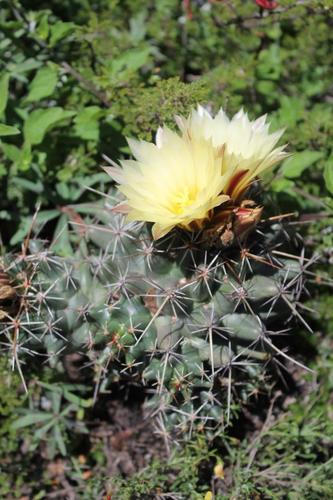
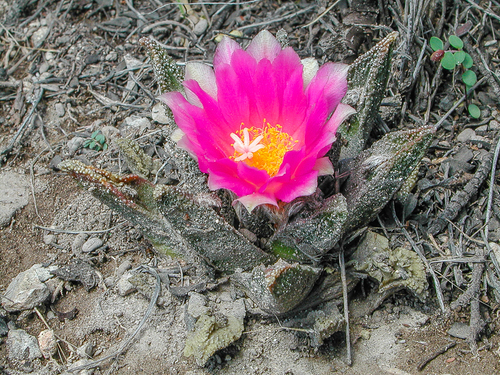
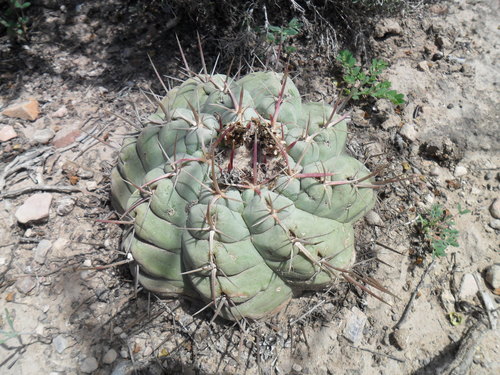
Thelocactus hexaedrophorus (Lem.) Britton & Rose is a solitary spherical cactus. Mature individuals grow 3 to 7.5 cm (1.2 to 3.0 in) tall and reach 8 to 15 cm (3.1 to 5.9 in) in diameter, with a body colored bluish, olive-green, or gray-green. This species has 8 to 13 ribs that are divided into warty, six-sided tubercles measuring 8 to 20 mm (0.31 to 0.79 in) long and 13 to 26 mm (0.51 to 1.02 in) wide. Its areoles are 4 to 13 mm (0.16 to 0.51 in) long, and spaced 2 to 3.5 cm (0.79 to 1.38 in) apart. The cactus bears 4 to 8 radial spines that are 5 to 60 mm (0.20 to 2.36 in) long, colored white, ocher, reddish, or brown, plus one central spine 2 to 3 cm (0.79 to 1.18 in) long. It produces large flowers 5 to 10 cm (2.0 to 3.9 in) wide, which range in color from white to pale pink. Its fruits are green to magenta, measure 7 to 11 mm (0.28 to 0.43 in), and become dry when they open. This cactus is endemic to limestone slopes in the Chihuahuan Desert, savanna, and grasslands of the Mexican states of San Luis Potosí, Zacatecas, Tamaulipas, and Nuevo León, where it grows at elevations between 1100 and 2000 meters. It occurs alongside a range of other plant species: Mammillaria parkinsonii, Mammillaria aureilanata, Ariocarpus retusus, Turbinicarpus saueri subsp. knuthianus, Coryphantha maiz-tablasensis, Astrophytum myriostigma, Echinocactus platyacanthus, Echinocereus enneacanthus var. carnosus, Coryphantha cornifera, Ferocactus latispinus, Echinocereus pectinatus, Echinocereus cinerascens, Opuntia rastrera, Opuntia lindheimeri, Cylindropuntia imbricata, Myrtillocactus geometrizans, Polaskia chende, Agave salmiana, Yucca filifera, Jatropha dioica, and Fritillaria affinis.