About Theligonum cynocrambe L.
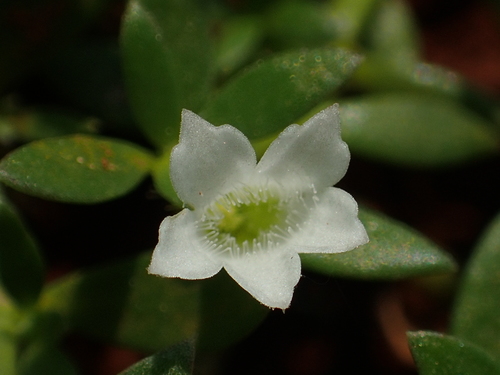
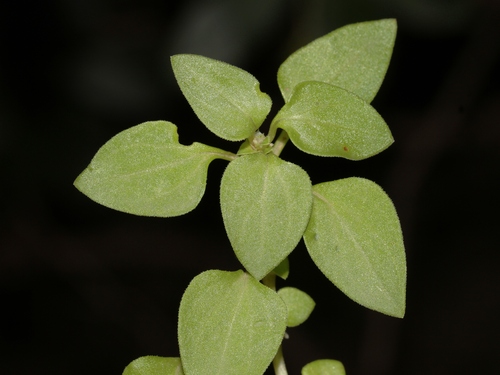
Theligonum cynocrambe L. is an annual herb that is typically hairless, growing low to short as a prostrate plant, and occasionally becoming erect. Its leaves are somewhat succulent, ovate, entire and untoothed; lower leaves are arranged oppositely, while upper leaves are alternate because one leaf of each original pair is suppressed. This species has distinctive united membranous stipules, and large club-shaped glands grow at the apex of each leaf. Its flowers are small, measuring 2–3 mm, green, insignificant, and have a membranous perianth. Flowers are unisexual, with both sexes present on the same plant, and grow in clusters containing 1 to 3 flowers each. Male flowers have a valvate to globose perianth that splits into 2 to 5 lobes when the flower opens. They hold 2 to 30 stamens, most often between 7 and 12, with filiform filaments; anthers are erect in the bud, and become pendulous later. Female flowers have a tubular perianth with short teeth, and an ovary formed from a single carpel that contains a single basal ovule. The style is simple and grows from the base of the ovary. When fruiting, the ovary enlarges irregularly on one side, and the style moves to a lateral position. The fruit is a subglobose nut-like drupe 2 mm across, containing one seed with fleshy endosperm. This species exhibits myrmecochory, meaning its seeds are dispersed by ants. Ants feed on the seed’s oil body, called an elaiosome, and often carry seeds some distance away from the parent plant. For this species, the oil body forms from a portion of the pericarp that stays attached to the base of the seed. Ants consume the oil body and leave the rest of the seed undamaged. Young shoots of Theligonum cynocrambe are sometimes eaten as a vegetable. It grows in rocky habitats, sandy ground, and old walls, most often in damp, shaded places. It flowers from February to June.