About Thelesperma filifolium (Hook.) A.Gray
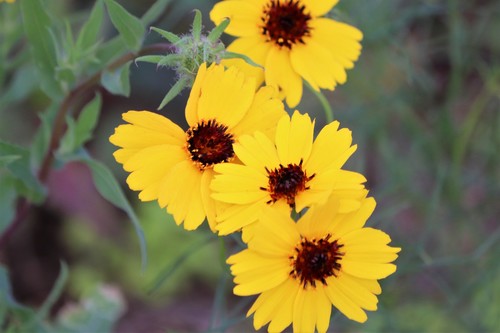
Thelesperma filifolium (Hook.) A.Gray, commonly called stiff greenthread, has a taproot. It is extremely drought resistant, but thrives in rainy conditions. The common name greenthread is very fitting, as this species has thin, thread-like leaves. It can be single-stemmed or multi-stemmed, and grows to a height of 12 to 26 inches. Its leaves are scattered along the entire length of its stem. The daisy-like flower heads measure 2 inches across, with eight golden-yellow ray florets, and numerous reddish to dark brown disk florets. Urn-shaped bloom buds droop downward before they open. The inner whorl of phyllaries surrounding the lower part of the bloom is translucent, letting the colors of the developing flower be seen through it. When the flower is open, two types of phyllaries are present at the base of the bloom: one type is short and green, while the other is long and red. In Texas, stiff greenthread grows along roadsides and on dry hills in the South Plains and Edwards Plateau regions. This herb grows across much of the plains and mountain states, reaching as far north as Wyoming, Montana, Nebraska and South Dakota. It grows prolifically on Navajo, Hopi, and Pueblo lands, as well as throughout most of New Mexico, Arizona and Colorado. Stiff greenthread occurs on disturbed sites with clay or sandy soils, on rocky slopes, and often grows on limestone. It is found at elevations ranging from 10 to 2200 meters, in South Dakota, Wyoming, Nebraska, Colorado, Kansas, Missouri, New Mexico, Oklahoma, Arkansas, Texas, Louisiana, Mississippi, and the Mexican states of Coahuila, Nuevo León, San Luis Potosí, and Querétaro. In ecological interactions, ripened seeds of this species are a food source for the multi-colored painted bunting. Deer do not appear to eat this plant. It acts as a larval host plant for the dwarf yellow butterfly. The crushed leaves of stiff greenthread produce a pleasant aroma, and can be used to make tea. This tea is sometimes used medicinally by several Native American tribes, especially among Southwest tribes, where it is known as Navajo tea, Hopi tea, or Indian tea. Stiff greenthread has a history of traditional use as a tea by Diné (Navajo) and Ndé (Apache) people. To make the medicinal tea, the stem, leaves, and flowers are steeped. The tea is used as an astringent, to reduce mucus secretions, reduce fevers, treat kidney problems, act as a vermifuge, relieve stomach aches and other digestive ailments, and treat sexually transmitted infections. Chewing the leaves of this plant is used to relieve toothache.