About Thecla betulae (Linnaeus, 1758)
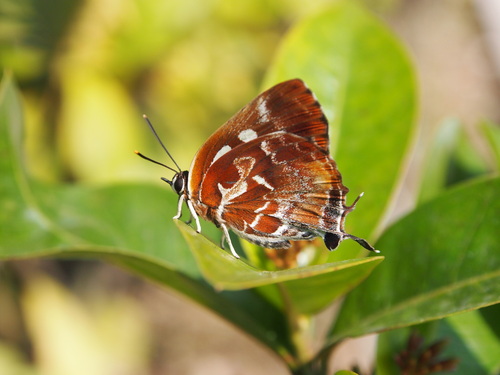
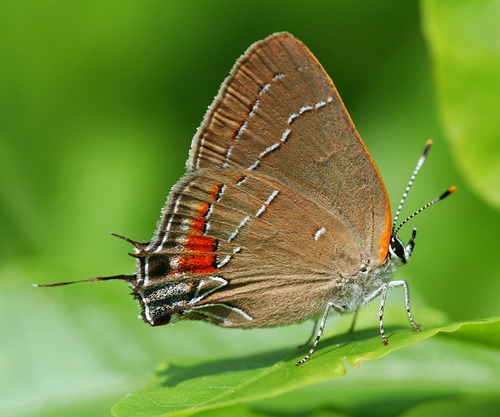
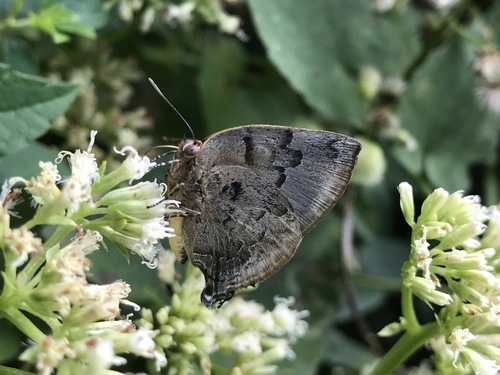
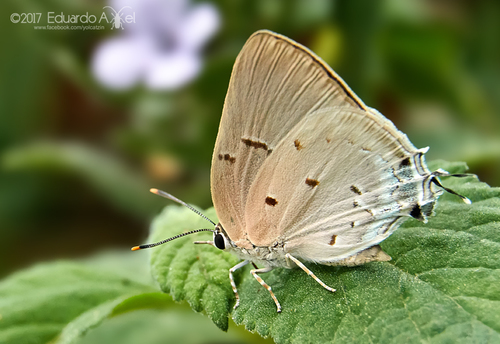
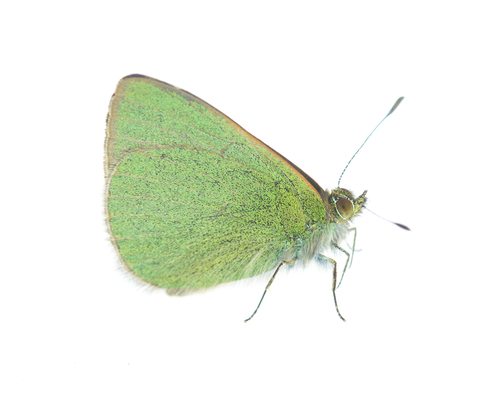
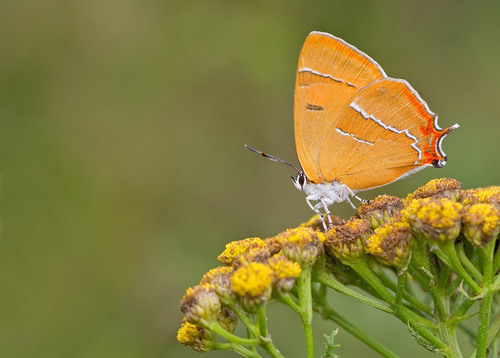
The brown hairstreak, scientific name Thecla betulae (Linnaeus, 1758), was first described in 1909 by Adalbert Seitz as follows. The upperside of the butterfly is black-brown. Males have a pale, diffuse patch, while females have a broad orange band beyond the crossveins. The underside is ochreous, marked with dark-edged white lines. This species is found in North and Central Europe, and Northern Asia eastward to the Pacific. Several named aberration forms are recognized: Tutt named males that lack the pale diffuse patch beyond the crossveins ab. unicolor; ab. pallida Tutt occurs when this patch is nearly white. In ab. spinosae Gerh., small orange spots appear beyond the apex of the cell; these spots are often paler yellow than the female's discal spots. When the female's orange discal band is narrow, it is called ab. restricta Tutt, and when it is broad it is called ab. lata. Females with a pale ochreous band instead of orange are ab. fisoni Wheeler; when heavy black veins divide the orange band into several separate spots, the form is ab. lineata Tutt. A very distinct form is ab. cuneata Tutt, which has a broad orange submarginal band on the hindwing. On the underside, the characteristic white lines are sometimes partially or fully lost or distorted; this variation is ab. nucilinea. When the white lines are strongly developed, and the space between the lines is dark, the lines are modified into a sort of white-edged dark band; this form is ab. virgata Tutt. There are three recognized geographical races. The race ongodai Tutt is the closest to the European form. Males have distinct discal lunules at the apex of the cell on the forewing, but no pale patch beyond the apex; the orange spots on the anal lobe of the hindwing and near the base of the tail are larger and more distinct. The female's orange spot is very narrow and is crossed by black veins. The race crassa Leech is much larger even than the largest European specimens (ab. major Tutt), its tail is longer, and the underside colour is sometimes (but not always) darker. It occurs in West China. The race elwesi Leech has an entirely orange upperside, except for the distal margin of the forewing and the sooty base of the hindwing; males bear brownish orange spots beyond the cell of the forewing. It is found in Central and West China. The egg of Thecla betulae is white, depressed, and rough-textured. Full-grown larvae are present in June. They are covered in short thin hairs, are green with a yellow line along the back and sides, have yellow subdorsal oblique spots, and a brown retractile head. Larvae feed on certain Prunus and Amygdalus species, and more rarely on birch, hazel, and cherry. The pupa is very smooth, rounded all over, and pale brown, with faint lighter and darker markings. Although it is only anchored by the cremaster, not by a silk girth, it lies closely pressed to its support with its underside against the surface. Adult butterflies fly from July until late October, and are found near woods, in avenues, and in gardens. They rest hidden among foliage, and can fly rather quickly and continuously. They visit flowers, especially umbellifers, and have also been observed feeding at bait. They are common in all areas where they occur, and can be very abundant in some years. Unlike what other observers have reported, this author sometimes saw 3 or 4 males resting together on a single leaf. In Europe, females lay their eggs on blackthorn (Prunus spinosa) in late August. The eggs overwinter, and hatch the following spring when buds open. The most effective way to locate breeding sites for this species is to search for its easily spotted white eggs during winter. Larvae have extremely effective camouflage, feed only at night, and stay completely motionless during the day. Pupation occurs in leaf litter on the ground in late June or early July. Ants are attracted to the pupae and bury them in shallow underground cells.