About Thaspium trifoliatum (L.) A.Gray
Species Classification and Growth Form
Thaspium trifoliatum (L.) A.Gray is an herbaceous perennial that reaches 30–91 cm (1–3 ft) in height.
Basal Leaf Characteristics
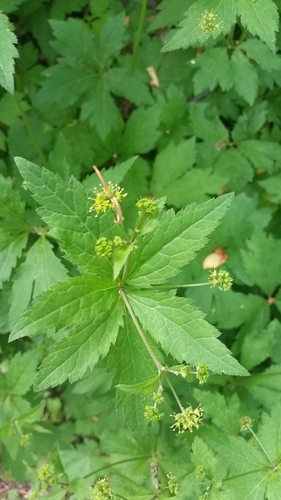
It produces a small number of basal leaves, which are roughly 3–10 cm (1–4 in) across and heart-shaped.
Stem Leaf Structure
Stem leaves grow alternately along the stem and are trifoliate, each bearing 3 lanceolate to ovate-lanceolate leaflets that are 3–5 cm (1–2 in) long.
Leaflet Features
Its leaflets are finely serrated and have a distinct white-translucent margin.
Inflorescence Type
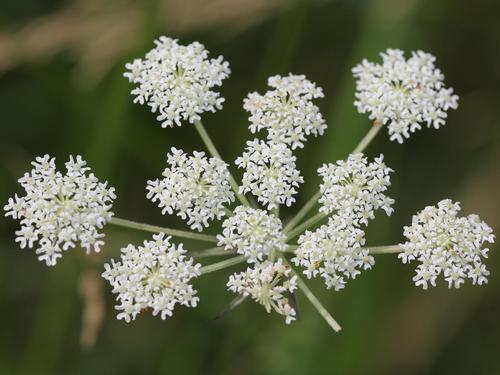
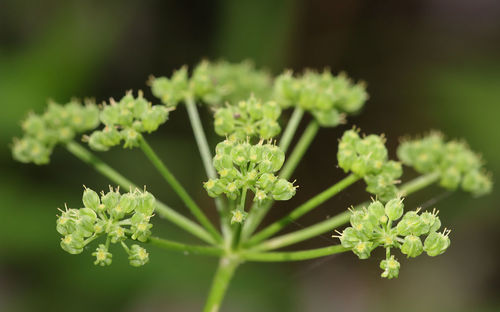
The inflorescence is a compound, flat umbel that holds very small flowers at the tips of upper stems.
Umbel Flower Position
The flower positioned at the center of the umbel sits slightly higher than all other flowers in the umbel.
Umbel Size
A single umbel measures 3–8 cm (1–3 in) across.
Flower Color and Bloom Period
The flowers are either golden yellow or dark maroon, and bloom from mid to late spring, with the seasonal window ranging from April to June depending on the region.
Similarity to Zizia aptera
The yellow-flowered variety of Thaspium trifoliatum strongly resembles Zizia aptera, and the two are often misidentified when plants are not bearing fruit.
Identification Distinctions from Zizia aptera
Thaspium trifoliatum can be told apart from Zizia aptera by its glabrous stem internodes (Zizia aptera has minutely puberulent stem internodes) and the pedicelled central umbellet flower (Zizia aptera has a sessile central umbellet flower).
Maroon-Flowered Population Identification
Maroon-flowered populations of Thaspium trifoliatum are easier to distinguish, as Zizia aptera produces only yellow flowers.
Ecological Role as Food Source
In its ecology, Thaspium trifoliatum acts as a food source for caterpillars of the black swallowtail (Papilio polyxenes) and Ozark swallowtail (Papilio joanae) butterflies.